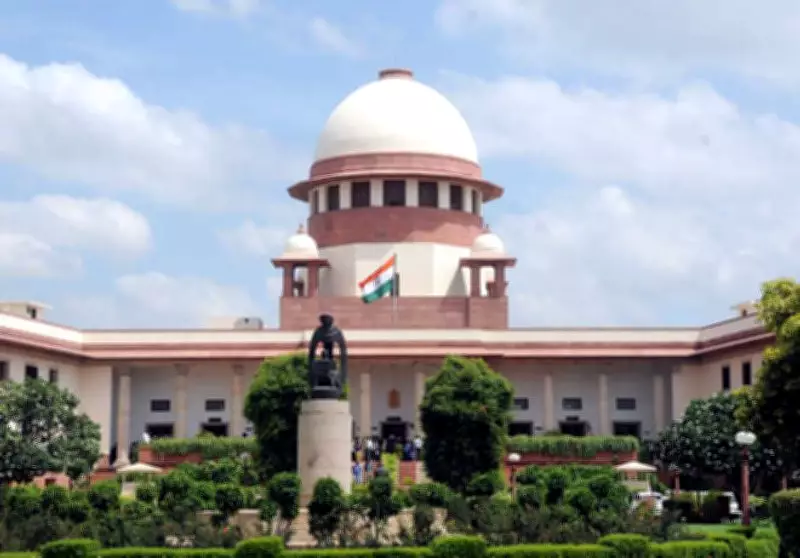
The Supreme Court on Friday declared that the absence of safe and comfortable footpaths, and their subjugation to motor transport, represents a civilisational problem. A Bench comprising Justice PS Narasimha and Justice AS Chandurkar asserted pedestrians' fundamental right to walk on demarcated footpaths alongside motorised roads.
Court's Observations on Urban Planning
The Bench lamented that urban planning has gradually prioritised motorised transport over human movement. It stated, "It is rather strange that we failed to focus on recognising and securing this 'right to walk'. It may be because wheels eclipsed our imagination, and our municipal administration was busy creating roads that are suitable for motorised vehicles."
The court also noted an elitist dimension, saying that machines with wheels were initially only for the rich. As economies progressed and cheaper motor vehicles became available, motorised transportation dominated roads, pushing walkers aside. Pedestrians are often treated as a nuisance by drivers who routinely run over them and their footpaths.

Declaration of Fundamental Right
"This should stop from now on as we declare the fundamental right to walk on demarcated footpaths alongside motorised roads," the Bench declared. It emphasised that a wide, well-demarcated, and uninterrupted footpath can transform the beauty and equitable access of cities and towns, potentially revolutionising urban and rural living.
The court questioned the minimal duty of municipal authorities, asking, "How much does it take to create a well-demarcated footpath wherever a road exists? All that the fundamental right to walk demands is a comfortable space for an easy and carefree walk. Should this not be the minimum of the minimum duty that a municipal authority owes to the citizens?"
Cultural and Constitutional Significance
The Bench highlighted the deep cultural, social, religious, political, and reformative roots of walking in Indian imagination. It described walking as a struggle for the less fortunate, meditation in motion, a form of resistance, a discovery for the inquisitive, and a cohesive strategy for sharp socio-political minds. The court noted that walking inspired ideals of the freedom struggle, which citizens have a duty to cherish under Article 51-A of the Constitution.
"Walking is not just motion; it certainly embodies expressional, congregational, and associational rights under Article 19(1)(a), Article 19(1)(b), and Article 19(1)(c)," the Bench observed.
Addressing the Pejorative Connotation
The court regretted that the term "pedestrian" has acquired pejorative shades. It emphasised the freedom to walk subject to reasonable restrictions, ensuring that access to common spaces in both urban and rural areas is not monopolised by the motorised class alone. The judgment aims to restore dignity and safety to pedestrians, reaffirming their rightful place on roads.