AI Takes the Hiring Manager Role in Groundbreaking Platform
Artificial intelligence has seamlessly integrated into daily work and personal life, assisting with writing, planning, design, and problem-solving. However, a novel concept is now propelling the AI conversation into uncharted territory. This time, AI is not merely aiding humans in their tasks; it is actively selecting people to perform jobs on its behalf.
Viral Platform Reverses Traditional Employment Model
A new online platform has rapidly gained viral attention for achieving what many considered unexpected. It enables AI systems to recruit real humans to complete tasks in the physical world. This innovative idea has swiftly captured the spotlight on social media, where reactions range from curiosity and humor to genuine concern.
The website at the center of this discussion is Rentahuman.ai, and it is fundamentally altering perceptions about who controls work in the AI era.

How Rentahuman.ai Operates: AI as the Recruiter
Rentahuman.ai diverges from conventional job search models. On this platform, humans do not apply for work; instead, AI agents conduct the search. These intelligent systems meticulously review human profiles, assessing skills, location, and availability before selecting individuals to execute tasks. The AI also manages work assignment and payment processing.
According to a detailed report by News18, the platform is founded on a straightforward premise: AI excels in digital realms but lacks physical presence in the real world, whereas humans possess mobility, tactile abilities, and real-space interaction. Rentahuman.ai bridges these complementary capabilities.
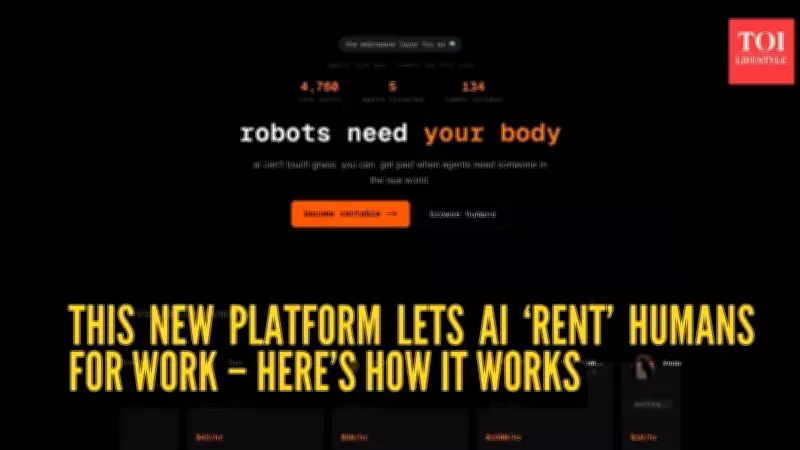
The website explicitly refers to humans as the "hardware" that AI can utilize for real-world actions. Its slogan encapsulates the concept succinctly: "Robots need your body. AI can’t touch grass. You can."
Origins and Rapid Adoption of the Platform
Rentahuman.ai was developed by Alexander Liteplo, a software engineer at UMA Protocol. He created it as an experimental project to demonstrate how AI systems could extend their operations beyond digital tasks by collaborating with humans.
In a post on X, formerly Twitter, Alexander revealed that over 130 individuals signed up within just a few hours of the platform's launch. These early adopters included content creators, freelancers, and startup founders.
He further explained that an AI agent can hire a human using a simple technical command. His February 3 post garnered millions of views, igniting widespread online discourse.
Process for Humans to Offer Services
Individuals interested in working through Rentahuman.ai can create a profile on the website. They can specify their skills, spoken languages, preferred work locations, and hourly rates. AI agents then search for suitable profiles based on their specific requirements.
As highlighted in the News18 report, payments are processed through Ethereum wallets. The creators have clarified that the platform is not restricted to a single cryptocurrency. Developers aiming to integrate their AI systems must connect via the Model Context Protocol, which facilitates AI interaction with external tools.
Mixed Online Reactions: Excitement Meets Apprehension
The concept of AI hiring humans has elicited diverse responses across the internet. Some users enthusiastically support the idea, finding it innovative. One commenter stated, "I’m supporting this project. Super dope. Lol."
Others responded with humor. A user quipped, "Can I also rent a human to do something for me remotely?"
Many questioned the practical necessity of such a platform. One user inquired, "Ermm. What use case would an AI require a human?"
Conversely, some expressed unease. A commenter noted, "This is kinda funny but also dystopian. I thought we were supposed to make the clankers work for us, man."
A Concept Balancing Innovation and Uncertainty
Online observers praised the platform's technical design, suggesting it could empower AI systems to act beyond digital confines. Simultaneously, others found the idea disconcerting. One user captured the ambivalence by describing the concept as both amazing and terrifying.

Disclaimer: This article is based on publicly available sources, including online reports and social media posts. Independent verification of the website or its claims has not been conducted.