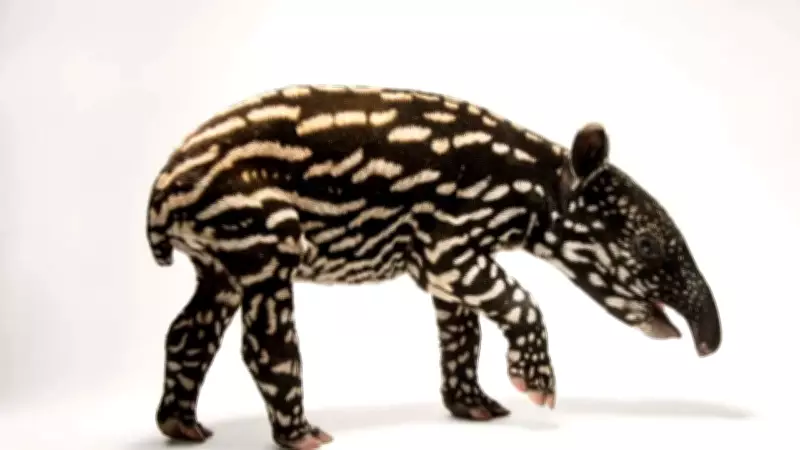
Baby tapirs are often described as looking like "walking watermelons" due to their distinctive striped and spotted bodies. However, this unique appearance serves a critical survival purpose rather than just being an oddity.
Why Baby Tapirs Have Stripes and Spots
The stripes and spots on a baby tapir's body are adaptations for surviving in dense forest habitats. From birth until they reach maturity, these animals face constant threats from predators. Instead of relying on speed or strength, they must conceal themselves. Their unique body patterns allow them to blend into their surroundings.
Disruptive Colouration as Natural Camouflage
All baby tapirs share the same pattern: dark brown fur streaked and spotted with white. This pattern is known as "disruptive colouration," which acts as camouflage by breaking up the body's outline, making it harder for predators to detect them. In forests where sunlight filters unevenly through leaves, the ground appears patchy. The baby tapir's markings mimic this patchy light, helping it stay hidden when it remains still.

Why the Watermelon Pattern Fades with Age
The watermelon-like pattern is temporary and changes as the tapir grows. According to research titled "Growth Rate & Pelage Colour Changes of a Captive Bred Malayan Tapir (Tapirus indicus)," the striped and spotted coat begins to fade within weeks and transforms into the adult colour pattern by around 15 weeks of age. As tapirs grow larger, their dependence on camouflage decreases. Instead, their size, alertness, and behavior help them avoid predators. This shift explains why the spotted fur coat disappears early in a baby tapir's life.
How Baby Tapirs Survive Early Life in the Wild
Baby tapirs are born relatively well-developed. Within a few hours of birth, they can stand and walk on their own, and they can swim within days. Much of a baby tapir's early life is spent out of sight. Tapir mothers typically leave their calves hidden in dense vegetation while they go out to feed, returning to nurse them. During this time, the striped coat plays an essential role in keeping them undetected.
Where Tapirs Live and Why Camouflage Matters
Tapirs inhabit dense forests in Central and South America and Southeast Asia. The Malayan tapir is the only tapir species found in Asia, adapted to tropical rainforest environments. These environments are filled with predators, and visibility is often limited due to dense vegetation. Patterned fur camouflage becomes a crucial survival strategy in such conditions, blending the young tapir with its surroundings.
More Than Just Looks
The watermelon-like pattern of baby tapirs is not merely an interesting feature; it is a survival tool that works during their most vulnerable stage of life. As they grow, the need for camouflage decreases, and their appearance changes accordingly. This adaptation demonstrates how animals evolve to meet their needs in specific environments. What may seem bizarre is often essential, as the appearance of animals is rarely random.