People often imagine all snakes from the same family to be almost identical – just different shades, different habitats, and the same danger. But when it comes to mambas, that assumption falls apart quickly.
The two most famous members – the Black mamba and the Green mamba – are often spoken about in the same breath, mostly because of their deadly reputation. Yet, if you actually look closely, they behave like two completely different species living very different lives.
Here are five key differences that quietly separate them, beyond just colour and fear factor.

1. The names are misleading from the start
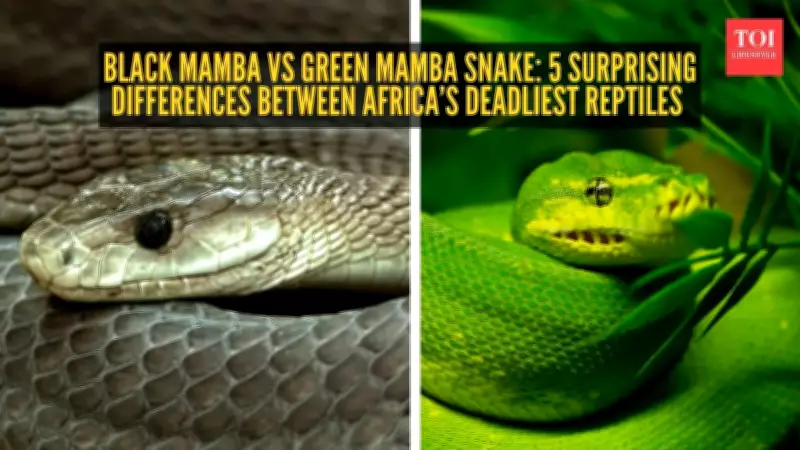
Let’s begin with the most confusing part – colour. The black mamba is not really black. Its outer body is usually greyish or olive-toned. The “black” refers to something you only see when it feels threatened – the inside of its mouth, which turns a dark inky shade as a warning display.
The green mamba, on the other hand, actually lives up to its name. Its body carries a bright, leafy green tone that blends almost perfectly with trees and dense vegetation. It doesn’t just look different – it feels like a completely different animal in motion.
2. Size changes the entire presence
Size is where the contrast becomes hard to miss. Black mambas are long, powerful, and can grow into one of the longest venomous snakes in the world, often stretching beyond 10 feet. That length, combined with their speed, gives them a reputation that feels almost exaggerated – until you see one move.
Green mambas are more slender and noticeably smaller. They rarely reach the dramatic lengths associated with black mambas, and their build feels lighter, almost delicate in comparison. But don’t let that fool you – they are still efficient hunters.
3. One owns the ground, the other owns the trees
Their choice of habitat tells you almost everything about their behaviour. Black mambas prefer open landscapes – dry savannas, rocky areas, and woodland edges. They are ground-dwellers, often moving quickly across land with surprising confidence and speed.
Green mambas take the opposite route. They are tree specialists. Most of their life is spent high in branches, weaving through leaves and staying hidden in thick green cover. If the black mamba dominates horizontal space, the green mamba dominates vertical space.
4. Behaviour: confrontation vs avoidance
This is where public fear really starts to separate from reality. Black mambas have a reputation for being defensive. When they feel cornered, they don’t hesitate to stand their ground, raise their head, and even strike repeatedly. Their speed adds to the intimidation – it’s not just aggression, it’s precision.
Green mambas are far more reserved. They tend to avoid confrontation whenever possible. Most encounters with humans end with the snake slipping away silently into the trees rather than standing its ground.
5. Same venom family, different risk story
Both snakes are venomous, but the way danger plays out is not identical. Black mamba venom is fast-acting and delivered in significant quantities, which is why untreated bites can become critical very quickly. That combination – speed, venom strength, and behaviour – is what builds its fearsome reputation.
Green mambas also carry medically significant venom, but bites are far less common simply because of their shy, tree-dwelling nature. They don’t cross paths with humans as often, which quietly lowers real-world risk.
The bigger picture
What stands out most between the two isn’t just biology – it’s lifestyle. One is built for speed on open ground, the other for silence among leaves. One reacts boldly when threatened; the other prefers to disappear entirely. In the end, they share a name, a family, and a reputation – but not the same way of living in the wild.
Disclaimer: This article is based on publicly available scientific studies and general informational sources on snake behaviour and characteristics.