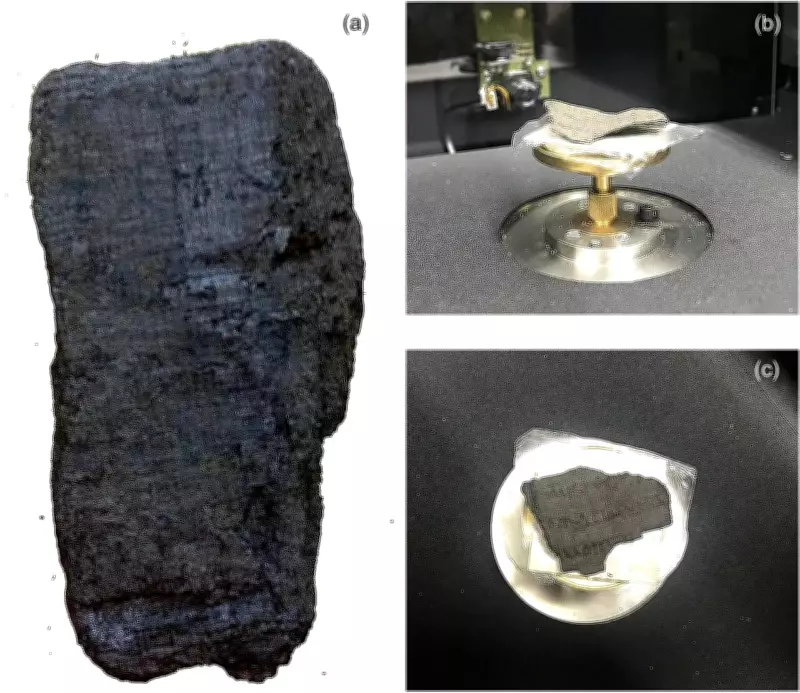
Imagine being a labourer in the mid-eighteenth century, digging through a tight and dank hole in the rock, breaking apart soil as hard as steel. You are digging near the legendary location of Herculaneum, the city that perished when Vesuvius erupted in AD 79. As you dig, you strike a cavity where you see rows of tiny, charred cylinders lying on shelved floors. To the labourers of the eighteenth century, these objects appeared no better than pieces of charcoal or charred branches from an old campfire. They could not imagine that these were the books of a perfectly preserved library from the Greco-Roman period.
The burnt rolls came to be known as the Herculaneum papyri. They had been kept in an extravagant and extremely luxurious house called the Villa of the Papyri, one of such splendour that it could only belong to the father-in-law of Julius Caesar. While the eruption of Vesuvius obliterated all objects in its wake, a strange miracle occurred involving these books. Rather than being reduced to ashes through the heat and pressure created by the volcano, they were carbonised. This made the organic material in the paper so brittle and black that it acted as a protective coating, holding the writings intact.
A Library Preserved Through Destruction
For the scientific community at the time, this was a revelation because it showed that ancient wisdom could perhaps be reclaimed after all. Unfortunately, until recently, this discovery was nothing but a tantalising riddle because attempts to read them meant they turned to dust when unrolled. As mentioned in the Herculaneum Scrolls put out by the National Endowment for the Humanities, these scrolls had been rolled up so tightly that they appeared as blocks of charcoal. What is more, the number of books made us re-evaluate our conception of the level of literacy and philosophical education of the ancient Romans. The approximate number of fragments found amounts to 1,800; thus, about 800 original volumes are thought to be present in the library collection. Moreover, the Herculaneum library collection is a highly selective book collection, which is why we can safely assume that it is one of the philosophical archives. As a result, the archive provided unique insights into the interests of the Roman nobility regarding the study of complex Greek philosophy and poetry.

Modern Methods of Decoding the Hidden Writing
The use of modern technologies in working with the Herculaneum papyri has become an integral part of modern history studies recently. In particular, we are not bound to the fragility of carbonised wooden sheets anymore. Instead, scientists use particle accelerators and sophisticated imaging techniques to see what is written on them without even unrolling the manuscripts and exposing their fragile structure. As per the paper titled Revealing letters in rolled Herculaneum papyri by X-ray phase-contrast imaging, it is possible to find out what Greek letters are written on them.
There is yet another intriguing aspect to this story when it comes to the nature of the ink. Until recently, it had been assumed that the ink used by the ancients was entirely carbon, meaning that it could not be differentiated from the carbonised papyrus sheets. However, recent research, called Revealing metallic ink in Herculaneum papyri, found that the ink used by the writers at the time contained lead. This leads to an ingenious solution that relies on 18th-century work and 21st-century science.
Today, the work continues as a global community of digital archaeologists competes to decipher the remaining scrolls. What began as a confusing discovery by a group of labourers in the 1750s has become one of the most important intellectual rescue missions in history. The Herculaneum library reminds us that even when history is buried under twenty meters of volcanic stone, it is never truly gone. It is just waiting for the right tool, or the right person, to bring it back into the light.
The idea that a library could be saved from destruction through the very flames that were set to burn it down is a chilling one indeed. It changes your perspective on useless items in this world.