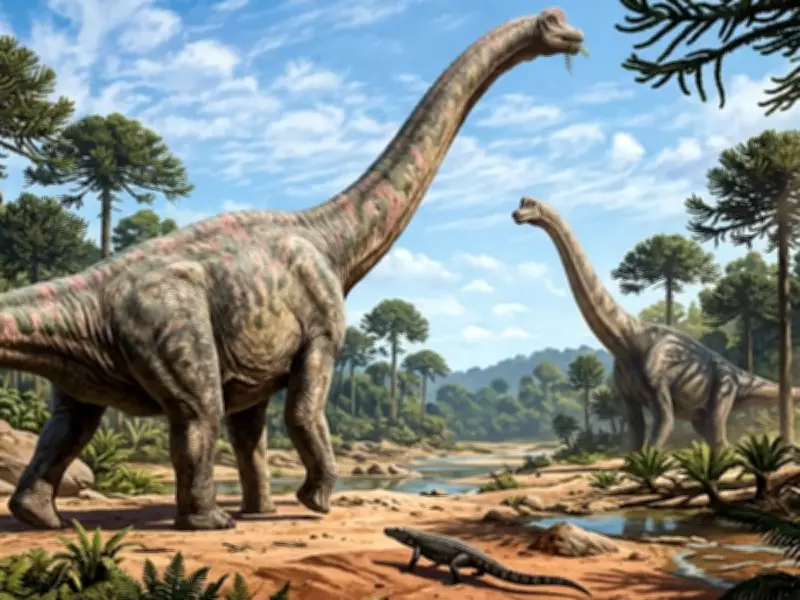
Imagine digging out the foundations of a new structure and accidentally uncovering something that has not seen sunlight in 120 million years. In the bustling city of Davinopolis, located in the Brazilian state of Maranhao, routine environmental monitoring for a construction project led to one of the most significant palaeontological discoveries in South American history. Eight meters below the surface, the skeletons of a massive creature challenge our understanding of how life traveled across the world before the continents separated.
A Giant Traveler Between Lost Worlds
This is not just a pile of bones; it is an entirely new dinosaur species with a neck extending 65 feet from tail to head. Scientists named it Dasosaurus tocantinensis, honoring the lush forests of the region and the nearby Tocantins River. Researchers who spent decades analyzing the fragile rock from granite emphasize that this find reminds us how ancient the surface beneath our feet truly is.
Dasosaurus's story is more than that of a massive creature; it is the tale of a wanderer. By studying the unique design of its vertebrae and its enormous 1.5-meter femur, scientists identified it as a sauropod, the famous plant-eating dinosaurs of prehistoric times characterized by small heads and strong tails that counterbalanced their huge bodies.

What makes this discovery shocking is its connection to a dinosaur found in what is now Spain. According to a study in The Journal of Systematic Palaeontology, the closest relative of the Brazilian dinosaur resided in Europe. This raises an intriguing mystery: how did these dinosaurs reach South America?
The answer lies in the supercontinent Gondwana. During the Early Cretaceous period, South America, Africa, Antarctica, and India were still connected, while Europe was an island archipelago. Researchers believe that between 140 and 120 million years ago, the ancestors of Dasosaurus migrated from Europe across Africa and into South America via land bridges now buried under the Atlantic Ocean. This finding provides evidence for ancient land pathways and shows that dinosaurs were among the greatest explorers of all time.
The Hidden Science of Growing a Titan
Beyond its journey, Dasosaurus teaches scientists about the biological blueprints for becoming large. The size of a bus requires a unique biological process: if a dinosaur grows too slowly, it becomes easy prey; if it grows too fast without proper bone structure, its weight could crush its legs.
By analyzing the microstructure of fossils, researchers discovered growth patterns that bridge the gap between sauropods and the more gigantic titanosaurs that ruled at the end of the dinosaur age. The study, titled The discovery of a new basal sauropod found in the Lower Cretaceous of Brazil, reveals how sturdy yet lightweight bones evolved earlier than previously thought. These internal structures allowed Dasosaurus to grow enormously while maintaining flexibility for survival in the dense, tangled woodlands of early Brazil.
Professor Elver Luiz Mayer from the Federal University of the São Francisco Valley explained that although Maranhao has produced smaller species like the 10-meter Amazonsaurus, nothing of this size had ever been discovered before. The completeness of this find, including arm bones, ribs, and foot bones, offers a rare high-definition look at an animal previously known only from fragmentary records.
Why Construction Sites Are Palaeontology's Best Friend
There is irony in how this massive discovery was made. In a country like Brazil, with thick vegetation and soil layers that conceal rock, scientists usually cannot see the ground beneath their feet. According to Professor Max Langer from the University of São Paulo, many of Brazil's most impressive fossil discoveries result from human activity. Roads, quarries, and massive building projects serve as accidental excavations that reveal rocks hidden for eons.

This accidental discovery process carries risks. Brazilian laws require monitoring on construction sites, but many fossils could be crushed by bulldozers before anyone realizes they exist. The successful recovery of Dasosaurus highlights the need for better cooperation between researchers and developers. Without the attentiveness of monitors in Davinopolis, this massive 65-foot creature could have turned into rubble rather than becoming an impressive museum centerpiece.
Currently, the remains of Dasosaurus tocantinensis are housed at the State Centre for Natural History and Archaeology Research in São Luís. They stand as a testament to a time when the globe was a single connected landmass, reminding us that beneath the sandstone of a modern construction site, an ancient legend may be waiting to be discovered.