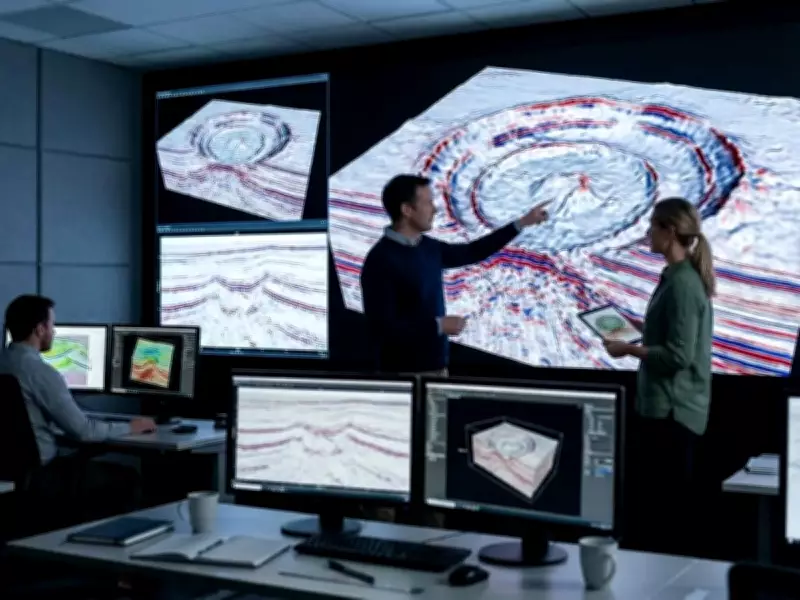
Scientists have confirmed the existence of a buried impact crater hidden beneath the Atlantic Ocean waters, courtesy of the use of state-of-the-art 3D seismic technology typically employed for seafloor imaging. The crater, known as Nadir Crater, is found offshore from West Africa, and while it has long been considered one of the suspected locations, there was no definite proof until now. Previous imaging results showed a round anomaly located under sedimentary layers. However, scientists now believe that the new imaging strongly suggests that the structure is indeed an impact crater formed by an asteroid.
Researchers believe that the crater formed during the Cretaceous-Paleogene time span, which corresponds to the era when dinosaurs went extinct about 66 million years ago. However, according to researchers, Nadir Crater is not responsible for the dinosaurs' extinction.
How the crater was confirmed by scientists
Previously, the available information to the research team consisted of only 2D seismic lines that revealed slices of the subterranean structure. However, the recently obtained 3D seismic survey allowed mapping the rim of the crater, associated fault systems, and the central uplift of the crater.

As reported in a 2024 paper published by Nature Communications Earth & Environment, the crater is estimated to be 5.7 miles (9.2 km) in diameter. In addition, scientists have detected a broader damage zone of about 23 kilometres in diameter surrounding the main crater. The researchers wrote in their paper that the outstanding imaging resolution makes it possible to detect the presence of the features of the crater in greater detail.
Significance of Nadir Crater’s discovery
Scientists point out that the importance of the discovery is that buried craters are challenging to prove. However, some circular structures could emerge due to volcanic activity or other tectonic processes. Nevertheless, the uplift, faulting, and deformation discovered within Nadir Crater are powerful indicators of the asteroid’s origin.
Unique feature of Nadir Crater
One of the unique features of Nadir Crater is that it is located under hundreds of meters of sediment layers on the Atlantic Ocean floor. According to the scientists from Heriot-Watt University, this is one of the most evident examples of the impact crater being buried underneath the ocean captured via seismic data. They stated that the depth of the crater below the surface of the sea is 300 meters.
The scientists noted that the usage of 3D technology played an important role in their study as it allowed them to see the crater as a whole, rather than in some isolated cross-sections. Thus, the presence of concentric fault rings, characteristic of many impact structures, as well as the presence of an annular moat, was revealed.
A crater from the age of dinosaurs
The age of the newly discovered crater is one of the most significant aspects of its discovery. Namely, Nadir Crater appeared during the same epoch when the impact at Chicxulub occurred in Mexico. It is known for causing the extinction of non-avian dinosaurs.
However, it is worth saying that the discovery cannot be directly linked with the impact at Chicxulub. Rather, scientists consider the crater formation as one of the few well-preserved traces of a significant event during the development of the planet.
According to Nature, seismic surveys at sea play an increasing role in studying the impact events that took place long ago, hidden by layers of sediment and covered by water.
What are the scientific benefits of discovering a buried crater?
Buried craters can offer important information regarding the Earth’s past. Over millions of years, any evidence of impact events can be erased due to geological processes. It is particularly hard to examine marine craters since they are submerged by hundreds of meters of sediment. For example, drilling into the structure might be costly or challenging to implement.
Thus, scientists see 3D seismic imaging as an effective method of exploring subterranean formations without physically entering the crater. The discovery of the Nadir Crater is based on numerous studies of impact events that took place over several decades. The first such example was the analysis of the Chicxulub crater.

Nadir now demonstrates how newer imaging techniques can uncover similar features beneath the Atlantic. Researchers say the discovery highlights how much of Earth’s history may still remain hidden below the ocean floor. With modern geophysical tools becoming more advanced, scientists believe more ancient impact scars could soon come into view.