Bengaluru: Cognizant is developing AI-led pricing and operating models centered on tokenisation as enterprises transition from human-led services to digital labour, according to CEO Ravi Kumar S.
Tokenisation as a Key Strategy
Speaking at a conference hosted by JPMorgan Chase, Kumar explained that tokenisation has become a major focus for the company. Clients increasingly seek assistance in managing the complexity and costs associated with AI-driven operations.
The Nasdaq-listed IT services company is introducing AI-enabled rate cards that move beyond traditional time-and-materials pricing models. These new cards account for varying levels of machine involvement in enterprise work. Cognizant had previously referenced these pricing models during its recent quarterly earnings call.

Rollout of Tokenised Rate Cards
The company is currently rolling out tokenised rate cards to select clients. These cards price work across a spectrum ranging from fully human-led delivery to hybrid models and increasingly autonomous AI-driven execution.
During the March-quarter earnings call, Kumar stated that this approach aims to align pricing with business outcomes and shared value creation. He added that the model could potentially unlock savings of $200 million to $300 million.
AI Maturity Framework
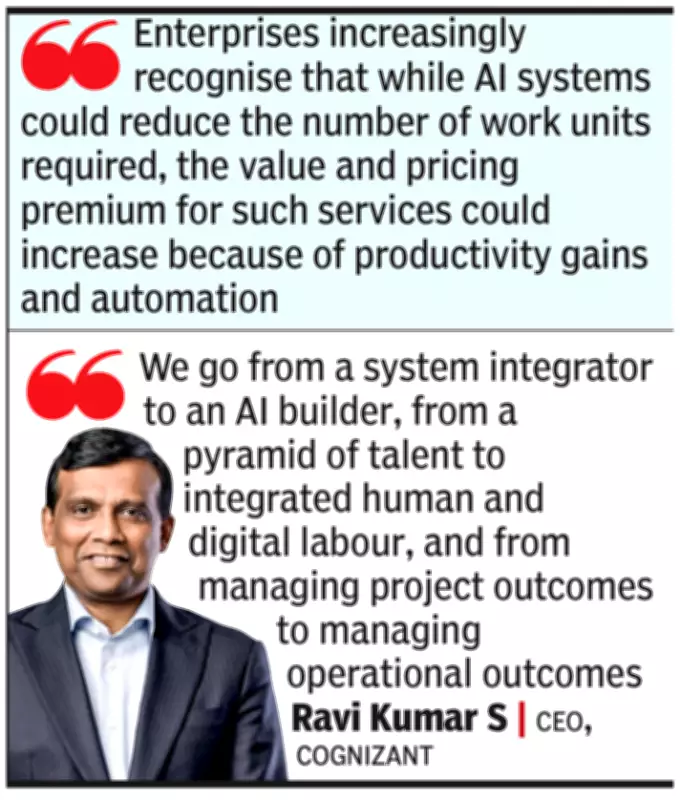
Kumar outlined an AI maturity framework ranging from A0, where work is entirely human-driven, to A3, where processes are fully autonomous. He noted that enterprises increasingly recognize that while AI systems may reduce the number of work units required, the value and pricing premium for such services could increase due to productivity gains and automation.
“Clients are saying as you go from A0 to A3, the premium on the rates will go up, but the number of units will go down because there are machines attached to it,” Kumar said.
Managing Machine-Driven Workloads
Kumar added that clients are increasingly asking technology providers to manage not just human effort but also machine-driven workloads and AI consumption costs. This shift is creating demand for scalable tokenisation frameworks that can manage AI inference costs, digital labour usage, and operational efficiency across clients.
Cognizant has started developing internal systems to track projects, people, and AI workloads to create standardized and repeatable delivery models.
Rethinking IT Services
Kumar stated that the rise of digital labour is fundamentally reshaping the role of IT services companies and forcing the industry to rethink traditional systems integration models.
“We go from a system integrator to an AI builder, from a pyramid of talent to integrated human and digital labour, and from managing project outcomes to managing operational outcomes,” he said.
Cognizant is also reorganizing around what it calls “frontier engineers” and “frontier operators”—teams designed to build AI-led systems and manage enterprise outcomes through a mix of human and digital labour.