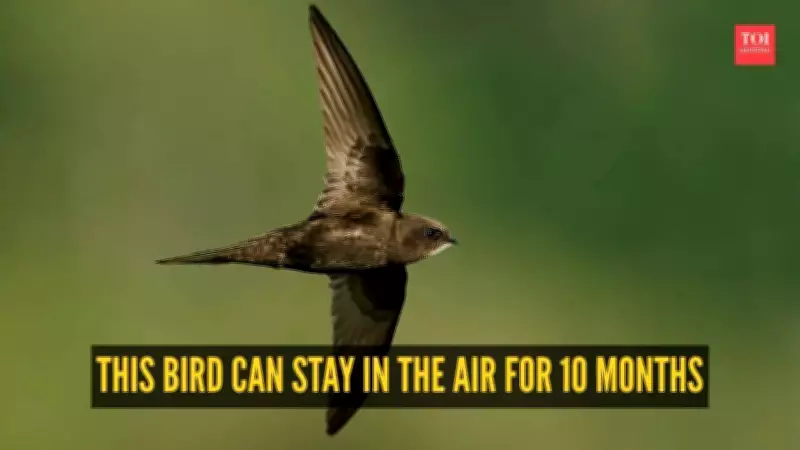
Nature often surprises us, but the common swift (Apus apus) stands out as one of the most astonishing birds. This small, streamlined bird has been recorded spending up to 10 months in the air without landing, making it one of the greatest endurance flyers in the animal kingdom.
Record-Breaking Aerial Endurance
A scientific study published in Current Biology reveals that common swifts remain airborne for 10 months of their non-breeding period. What makes this fact remarkable is that the bird does not merely fly for a few hours or days; it spends the majority of its non-breeding life in the air. For many birds, flight is a way to move from one place to another. For the common swift, flight is a way of life.
What Makes the Common Swift So Special
The common swift is built for the air. It possesses long, narrow wings, a lightweight body, and a shape that facilitates efficient gliding. Swifts rarely touch the ground and perform many life activities while flying. They can eat, drink, clean themselves mid-flight, and even mate on the wing. Their body structure is not designed for walking on land. In fact, swifts have very short legs and are far more comfortable clinging to vertical surfaces than standing on the ground. This is one reason they spend so much time in the air: their entire anatomy is adapted for flight rather than for life on the ground.

The bird's flight efficiency also plays a huge role. Swifts are strong long-distance migrants, and during migration they travel huge distances while conserving energy. According to various sources, the common swift's annual journey can cover around 14,000 miles, with most of that time spent flying. That kind of endurance is possible only because of the bird's aerodynamic design and efficient use of air currents.
How Can It Survive Without Landing?
One of the biggest questions people ask is how a bird sleeps, feeds, and survives without touching down. Swifts have developed clever adaptations that allow them to rest while staying airborne. Swifts can alternate activity between their two brain hemispheres, which helps them rest while continuing to fly. Their food source also makes life in the sky possible. Swifts feed on insects caught during flight, so they do not need to land to search for food. They also drink while flying. This means that many of their basic needs can be met without ever stopping.
Studies have found that some swifts may remain airborne for the entire non-breeding season, returning to land only when it is time to breed. This makes the common swift one of the rarest examples of a creature whose natural lifestyle is almost completely aerial.
Why This Bird Matters in Science and Conservation
The common swift is not just an impressive bird; it is also scientifically important. Its flight behaviour has helped researchers understand how birds conserve energy, navigate long distances, and rest in unusual ways. At the same time, swifts face conservation challenges. These birds depend heavily on nesting sites in buildings and other structures, and habitat changes can affect their populations. Swifts are also closely tied to their breeding sites and spend long periods away from them. Protecting nesting places is therefore important for helping the species survive.
This is not only surprising but also shows how evolution can create extraordinary survival solutions. A bird that can remain airborne for ten months reminds us that nature achieves seemingly impossible feats. The common swift is a true marvel of the natural world. With its powerful wings, lightweight body, and unique lifestyle, it can stay airborne for up to ten months, feeding, resting, and moving across vast distances without landing. This incredible ability makes it one of the most fascinating birds in the world.