For centuries, Dante Alighieri's Inferno has been treated as theology, political commentary, and medieval literature folded into one long descent through Hell. The poem's architecture is familiar even to readers who have never completed it: descending circles, violent punishments, and a vast crater beneath the Earth where Lucifer remains trapped after falling from Heaven. What has drawn fresh attention this year is not the religious imagery itself, but the physical shape of that world. A researcher presenting at the European Geosciences Union General Assembly argued that parts of Dante's underworld resemble the mechanics of a planetary impact event in ways that feel unexpectedly close to modern geology. The idea is not being framed as hidden science. It sits somewhere between literary interpretation and geomythology, where ancient narratives are compared with natural processes recognized much later.
How Dante's Inferno Resembles a Giant Asteroid Impact
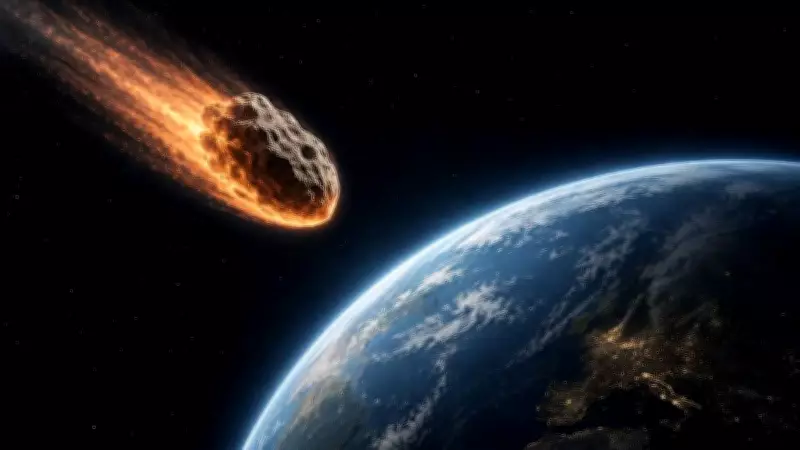
According to the abstract presented at the EGU26 general assembly, the argument centers on Dante's description of Satan crashing into Earth after being expelled from Heaven. The impact, as described in Inferno, hollows out a massive cavity beneath Jerusalem, creating Hell itself, while displaced land rises on the opposite side of the globe to form the mountain of Purgatory. According to the European Geosciences Union (EGU), the study argues that researcher Timothy Burbery suggests that the sequence resembles modern interpretations of impact dynamics, particularly the excavation and displacement associated with large asteroid strikes. The structure of Hell, descending inward through nine circular layers, is also discussed in relation to crater morphology and concentric impact basins.
The comparison becomes stranger the longer it is examined. Dante was writing in the early 14th century, long before impact craters were scientifically understood and centuries before meteorites themselves were widely accepted as extraterrestrial objects. Yet the poem repeatedly treats Lucifer's arrival not as symbolic drifting, but as a violent physical event that reshapes the planet.

Dante's Inferno and Geomythology: Why Researchers See Asteroid Parallels
The research does not argue that Dante possessed scientific knowledge of asteroid impacts. That distinction appears repeatedly in the conference material. As reported, the work belongs more comfortably within geomythology, a field that studies whether ancient myths and literary traditions may preserve echoes of natural disasters or geological observations. Flood narratives, volcanic eruptions, and unusual celestial events have all been examined through that lens before. In this case, the interest lies in how closely Dante's fictional geography overlaps with concepts recognized in modern planetary science. Burbery's presentation compares elements of Inferno with features associated with impact excavation, ejecta displacement, and concentric crater formation. The suggestion is partly literary and partly structural. The resemblance itself is what attracted attention.
There is also the possibility that medieval thinkers were more attentive to Earth processes than modern readers sometimes assume. Dante's work frequently references astronomy, geography, and cosmology as they were understood in his time. His universe was deeply ordered, mathematical in places, and heavily influenced by Aristotelian and Christian cosmological systems.
Why Dante's Inferno Asteroid Theory Is Drawing Attention
Part of the fascination comes from the contrast between medieval literature and planetary science. The image of a 14th-century poet accidentally describing something resembling impact physics carries an immediate novelty, even if the overlap may ultimately be coincidental. The proposal gained wider visibility after coverage from science publications highlighted the crater-like structure of Dante's Hell and the mechanics behind Lucifer's fall. Much of the public discussion has focused on whether the similarities are meaningful or simply the result of retroactively applying scientific language to a symbolic narrative.

That uncertainty is still there. The presentation itself appears cautious about making direct scientific claims. As reported in the abstract, it frames the comparison as an interpretive exercise rather than evidence of historical knowledge about asteroid impacts. Even so, the argument touches on a broader pattern in historical writing. Ancient and medieval texts are often revisited after scientific discoveries reshape the way natural events are understood. Descriptions once treated as purely mythical sometimes gain new readings when viewed alongside geology, volcanology, or astronomy.
Dante's Inferno and the Geological Details Behind the Theory
Dante's underworld was never intended as a scientific model. Its shape was theological before anything else. Sins descend deeper into the Earth according to moral severity, ending with Lucifer immobilized at the center of the world. Still, the physical details are unusually concrete. Land is displaced. A crater forms. Matter is pushed outward and upward elsewhere on the globe. The landscape changes because of the impact. Those details are what separate this interpretation from a casual metaphor. Medieval depictions of Hell were common long before Dante, but Inferno gives the space a kind of physical engineering. The Earth reacts to the fall. Whether that resemblance says anything deeper about medieval imagination remains unresolved. The presentation does not attempt to prove that Dante anticipated modern geology, only that his descriptions align in surprising ways with concepts developed centuries later. For now, the theory sits in an unusual space between literature, mythology, and Earth science. That may be why it continues circulating beyond academic circles. It asks readers to return to one of the most studied poems in European history and look at its geography, not just its symbolism.
About the Author
The TOI Science Desk stands as an inquisitive team of journalists, ceaselessly delving into the realms of discovery to curate a captivating collection of news, features, and articles from the vast and ever-evolving world of science for the readers of The Times of India. Consider us your scientific companion, delivering a daily dose of wonder and enlightenment. Whether it's the intricacies of genetic engineering, the marvels of space exploration, or the latest in artificial intelligence, the TOI Science Desk ensures you stay connected to the pulse of the scientific world. At the TOI Science Desk, we are not just reporters; we are storytellers of scientific narratives. We are committed to demystifying the intricacies of science, making it accessible and engaging for readers of all backgrounds. Join us as we craft knowledge with precision and passion, bringing you on a journey where the mysteries of the universe unfold with every word.