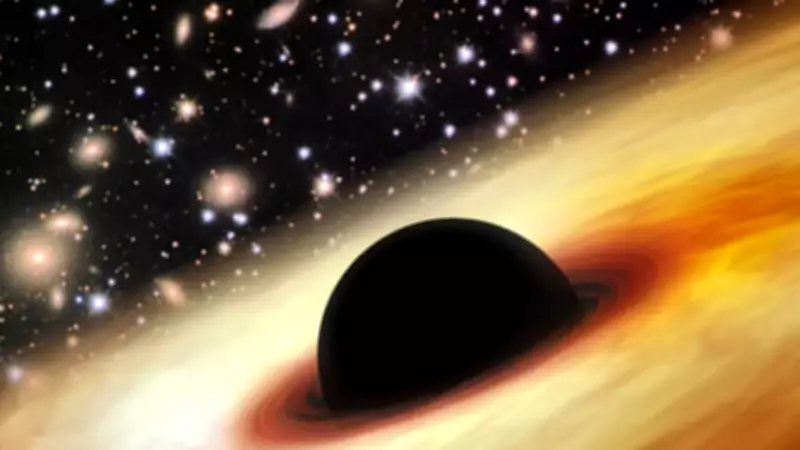
For years, astronomers have been grappling with a puzzling aspect of the early universe: the existence of supermassive black holes with masses up to one billion times that of the Sun, formed less than a billion years after the Big Bang. This phenomenon defies current scientific explanations for black hole evolution, which typically require stars to collapse and gradually grow over time. However, recent observations from the James Webb Space Telescope have revealed these ancient giants, suggesting an unknown force may be at play. Dark matter, the invisible substance that makes up most of the universe's matter, could be the key.
Scientists Explore the Hidden Impact of Decaying Dark Matter
According to a study published in IOP Science titled 'Direct collapse black hole candidates from decaying dark matter', dark matter is an invisible substance that neither reflects nor emits light and interacts weakly with other matter, yet influences galaxies through gravity. In their research, scientists investigated a new angle: the decay of dark matter particles, which releases a small amount of energy into space. While each particle's energy emission is negligible, researchers believe that in the early universe, which was primarily composed of hydrogen, this minimal energy input could have had significant effects.
Dark Matter Decay Could Trigger Direct Black Hole Formation
Under normal circumstances, gas clouds cool and fragment, leading to star formation. However, the study suggests that if decaying dark matter releases energy into these clouds, it can impede cooling. This prevents fragmentation, causing the cloud to collapse directly into a massive black hole without forming stars first. This process, known as direct collapse, could explain the rapid formation of supermassive black holes shortly after the universe began. Scientists theorize that this mechanism may occur when dark matter particles have a mass between 24 and 27 electronvolts, as reported by Space.com.

Insights from the James Webb Space Telescope
The James Webb Space Telescope has been instrumental in raising these questions. Its discoveries include galaxies and black holes that appear more developed than expected given their age, challenging current theories of cosmic evolution. Direct collapse black holes were already a plausible explanation but seemed to require extraordinary conditions, such as intense radiation from surrounding stars affecting gas clouds. However, the dark matter theory suggests that such conditions may be more common than previously thought.
How Small Dark Matter Effects May Have Had Massive Consequences
One striking aspect of the study is the scale of energy involved. Each decaying dark matter particle releases an extremely small amount of energy, far less than everyday sources. Yet the cumulative effect across vast regions of space could be significant. Early universe gas clouds were unstable systems, dependent on a delicate balance between heating and cooling. Even a slight shift in this balance could determine whether stars formed or a black hole emerged directly. Researchers suggest that these early environments may have acted as natural detectors for dark matter activity, offering a new way to connect particle physics with cosmic evolution.
New Research Adds Another Piece to the Supermassive Black Hole Puzzle
The theory that dark matter decay leads to supermassive black holes is still under investigation and has not been confirmed. More observational and theoretical studies are needed. However, it is clear that the presence of these massive black holes in the early universe contradicts existing theories, leaving many unanswered questions. This research provides a compelling new direction for understanding one of cosmology's greatest mysteries.