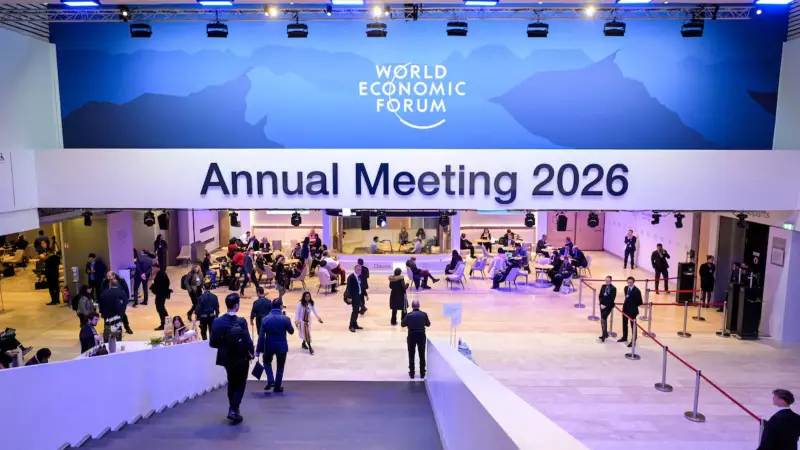
At the World Economic Forum's annual gathering in Davos, Switzerland, business leaders expressed strong optimism about artificial intelligence's capacity to create new employment opportunities, even as concerns about job losses and workforce disruption continue to linger in the global economic landscape.
Corporate Optimism Meets Workforce Anxiety
Top executives gathered in the Swiss mountain resort maintained that while certain jobs might disappear due to technological advancement, numerous new positions would emerge across various sectors. Several leaders specifically noted that artificial intelligence would likely serve as a convenient justification for companies that were already planning workforce reductions, rather than being the sole cause of employment changes.
Industry Leaders Champion AI's Employment Potential
Prominent advocates for AI's trillion-dollar expansion, including Nvidia CEO Jensen Huang, emphasized how the technology could lead to higher wages and increased job opportunities for skilled tradespeople such as plumbers, electricians, and steelworkers. Huang specifically highlighted multiple industries creating employment through technological advancement.

"Energy is creating jobs. Chips industry is creating jobs. The infrastructure layer is creating jobs," Huang told the Davos assembly, repeatedly emphasizing the employment potential with his declaration of "Jobs, jobs, jobs."
Undercurrents of Skepticism and Concern
Despite this surface optimism, significant skepticism about artificial intelligence's impact simmered throughout the discussions. Delegates engaged in serious conversations about potential negative consequences, including how certain AI applications like chatbots might contribute to consumer mental health issues. Labor union representatives raised important questions about who truly benefits from recent technological gains.
Christy Hoffman, general secretary of the 20-million-member UNI Global Union, offered a critical perspective: "AI is being sold as a productivity tool, which often means doing more with fewer workers."
Practical Implementation and Business Challenges
Business leaders discussed the practical realities of implementing artificial intelligence across industries. Rob Thomas, IBM's chief commercial officer, noted that AI has progressed to a stage where companies can realistically expect returns on their investments.
"You can truly start to automate tasks and business processes," Thomas explained, highlighting the technology's growing maturity.
However, research from advisory firm PwC revealed that only one in eight CEOs surveyed believed artificial intelligence was actually reducing costs and generating additional revenue. Significant questions remain about sustainable business models that can justify AI's substantial implementation expenses.
Real-World Success Stories
Several executives shared concrete examples of AI delivering tangible benefits. Cathinka Wahlstrom, chief commercial officer at BNY, reported that artificial intelligence has dramatically reduced research time for onboarding new clients from two days to just ten minutes. Similarly, Jeetu Patel, President of networking company Cisco, described how projects previously considered too labor-intensive are now being completed in weeks rather than years.
"The way in which we code actually was rethought," Patel noted, suggesting that software developers should embrace AI not merely for productivity gains but to maintain long-term professional relevance.
Corporate Strategies and Workforce Implications
Different companies are approaching artificial intelligence implementation with varying workforce strategies. Rob Goldstein, BlackRock's chief operating officer, explained that the world's largest asset manager views AI primarily as a tool for business expansion rather than workforce reduction.
"We're very focused on keeping our headcount flat as we continue to grow," Goldstein stated during a media roundtable discussion.

Meanwhile, other corporations like Amazon.com are reportedly planning additional workforce reductions, with sources indicating a second round of cuts targeting approximately 30,000 corporate positions. This contrast highlights the divergent approaches companies are taking toward artificial intelligence and employment.
Worker Perspectives and Systemic Concerns
Luc Triangle, general secretary of the International Trade Union Confederation, identified a crucial factor contributing to persistent workforce anxiety: "Part of the reason anxiety about jobs persists despite corporate assurances is if workers have little say in the rollout of AI." When employees feel excluded from decision-making processes, Triangle noted, they naturally perceive artificial intelligence "as a threat."
Broader Perspectives on AI's Future
Microsoft co-founder Bill Gates offered a balanced view of artificial intelligence's potential impact, urging preparation for both opportunities and disruptions. "Your economy gets more productive," Gates observed. "That's typically a good thing." The billionaire philanthropist suggested potential policy measures like taxing AI activities to assist affected workers while encouraging politicians to develop greater familiarity with the technology.
Gates maintained an ultimately optimistic perspective: "There certainly are problems, but they're all solvable problems."
Closing Optimism from Tech Visionaries
The Davos gathering concluded with notable optimism from technology entrepreneur Elon Musk, who emphasized the importance of maintaining positive outlooks despite challenges. "For quality of life, it is actually better to err on the side of being an optimist and wrong, rather than a pessimist and right," Musk told a packed congress hall before departing the event.
Throughout the discussions, the tension between artificial intelligence's promised benefits and its potential disruptions remained palpable, with business leaders generally emphasizing job creation possibilities while acknowledging legitimate concerns about workforce transitions and implementation challenges.