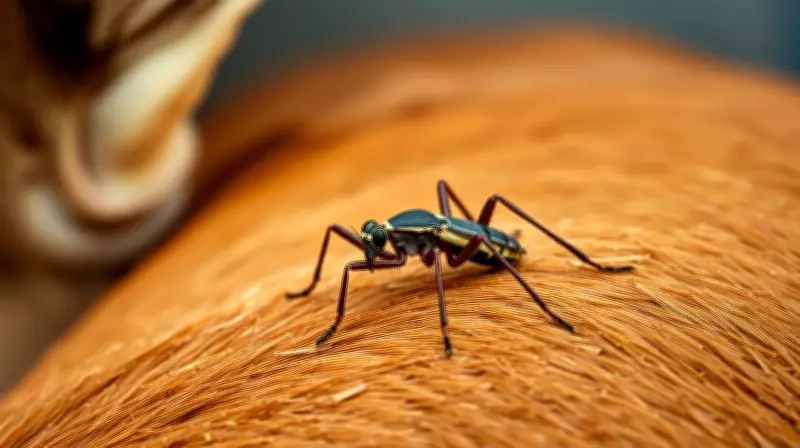
A small blood-feeding fly found across Europe, Asia, Africa, and the Americas undergoes one of the most dramatic lifestyle switches in the insect world, and according to new research, its eyes change as much as its body does. The deer ked starts life as a winged adult that flies and uses sharp vision to track down a host, usually a deer, though it will occasionally settle for a human. The moment it finds one, it snaps off its wings permanently and spends the rest of its life as an ectoparasite, crawling through fur and feeding on blood. Scientists from Aberystwyth University and the University of Florence have found that this switch comes with a measurable cost to the fly's eyesight.
What is a deer ked and why does it lose its wings
Deer keds belong to a family of biting flies whose relationship with flight varies enormously across species, with some never developing wings at all. According to the study published in the Journal of Experimental Biology, the species studied, Lipoptena andaluciensis, follows a more unusual path, flying only long enough to locate a suitable host before abandoning flight for good. Once a deer ked lands on an animal, it deliberately breaks off its own wings and becomes a permanent ectoparasite, living in the host's fur and feeding on blood for months at a time. Because the insect never moults again after this transition, the hard outer structure of its eyes, including its lenses and facets, cannot be physically rebuilt or replaced once flight is abandoned.
How researchers studied the deer ked's changing vision
To understand what happens to vision during this dramatic transition, researchers led by Dr. Roger Santer of Aberystwyth University's Department of Life Sciences, working with colleagues at the University of Florence, collected deer keds at two very different life stages near woodland edges in Tuscany, Italy. According to Aberystwyth University's official statement, winged adults were caught while actively flying and searching for a host, while wingless adults already living as parasites were collected directly from deer carcasses after recent hunting kills. The team then compared activity levels of opsin genes, which build the light-sensing proteins inside insect eyes, between the two groups to see how vision changes once flight is permanently given up.

Why a flying deer ked's eyes resemble a tsetse fly's
Before landing on a host, flying deer keds turned out to have a visual system built for serious host-hunting. Santer explained that a flying deer ked's visual system closely resembles that of the tsetse fly, the well-known African bloodsucker famous for tracking down mammal hosts purely by sight. The flies carry the same five opsin types found in tsetse flies: a general-purpose pigment tuned for detecting motion and brightness, a set of three opsins handling colour vision across ultraviolet, blue, and green light, and one additional opsin dedicated to the simple eyes on top of the head that help stabilise flight. This full sensory toolkit allows host-seeking deer keds to spot a deer from a distance, much like their tsetse fly relatives.
What happens to a deer ked's vision after it loses its wings
Once a deer ked sheds its wings and settles permanently on a host, its visual system undergoes a measurable decline. According to the study, activity of the fly's opsin genes drops to around half of the level recorded in flying adults. Santer noted that this finding suggests the flies do not lose vision entirely, but that their visual sensitivity becomes substantially reduced once flight is no longer needed. Because the eye's external structure cannot be rebuilt after the insect's final transition, this reduction has to happen entirely at the level of internal gene activity rather than through any physical change to the eye itself, making the deer ked an unusually clean natural example of sensory systems adjusting after a major lifestyle shift.

Why sacrificing sight helps a deer ked survive as a parasite
Vision is a useful but expensive sense to maintain, and that trade-off appears to drive the deer ked's reduced eyesight. In some related blowflies, the retina alone can consume roughly a tenth of the insect's entire oxygen budget, a substantial cost for a sense that becomes largely unnecessary once a fly stops flying and starts living permanently on a host. Santer suggested the fly may be sacrificing some of its sight specifically to conserve energy for functions that matter far more during its parasitic phase, such as digestion and reproduction. The researchers say a better understanding of how deer keds and similar biting flies allocate their senses could eventually support improved methods for monitoring and controlling these blood-feeding parasites in the wild.