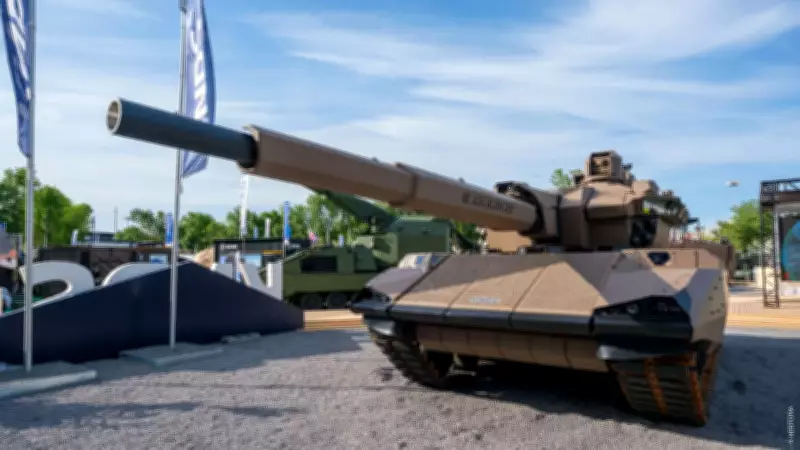
A new battle tank, the Capint, was unveiled by Amsterdam-based European defence firm KNDS at Eurosatory 2026, the world's largest defence exposition. The armoured vehicle pairs a German Leopard 2 hull with a French-developed unmanned turret and a 120 mm smoothbore gun that can be upgraded to 140 mm.
Capint: A Hybrid Design for Europe
KNDS positions the hybrid design as a replacement for France's aging Leclerc tanks in the 2030s, bridging the gap until the delayed Franco-German Main Ground Combat System (MGCS) is expected in the mid-2040s. The company stresses that Capint is not merely a stopgap but a foundation for a next-generation combat system, integrating artificial intelligence, advanced protection suites, counter-drone capabilities, and beyond-line-of-sight engagement.
The vehicle reflects Europe's effort to keep heavy armour relevant amid evolving threats, particularly from Russia. Future main battle tanks show a global shift toward digitisation, autonomy, and hybrid warfare.

Global Trends in Armoured Warfare
The United States is developing the M1E3 Abrams, a lighter, digitally networked evolution of its iconic tank featuring hybrid propulsion and AI-assisted targeting. Russia's T-14 Armata already features an unmanned turret, active protection systems, and drone integration, setting a benchmark for fourth-generation armour. China's Type 100 Smart Tank emphasises AI-driven navigation, modular armour, and hydrogen fuel cells, designed to operate in robotic platoons.
Europe is pursuing two complementary paths: the interim KNDS Capint, which combines a Leopard 2 hull with a French unmanned turret, and the longer-term MGCS program, a "system of systems" that will integrate crewed and uncrewed vehicles. Both programmes underscore the global race toward modular, AI-enabled, and cyber-hardened armoured warfare.
India's Future Ready Combat Vehicle (FRCV)
India is following a parallel modernisation track with its Future Ready Combat Vehicle (FRCV) programme, initially aimed at replacing the T-72 fleet. The FRCV envisages a highly digitised, network-centric platform capable of human-machine teaming and of controlling unmanned systems such as UGVs, UAVs, and loitering munitions. It will incorporate battlefield management systems, friend-or-foe identification, and cyber-hardened communications to operate in contested electronic-warfare environments.
Designs stress 360-degree situational awareness through panoramic sensors, tethered-drone capability, and counter-drone measures. Navigation will rely on hybrid systems compatible with India's IRNSS satellite network and inertial guidance. By embedding ISR and loitering-munition strike capability directly into the platform, India aims to turn its tanks into nodes of a larger integrated combat network.