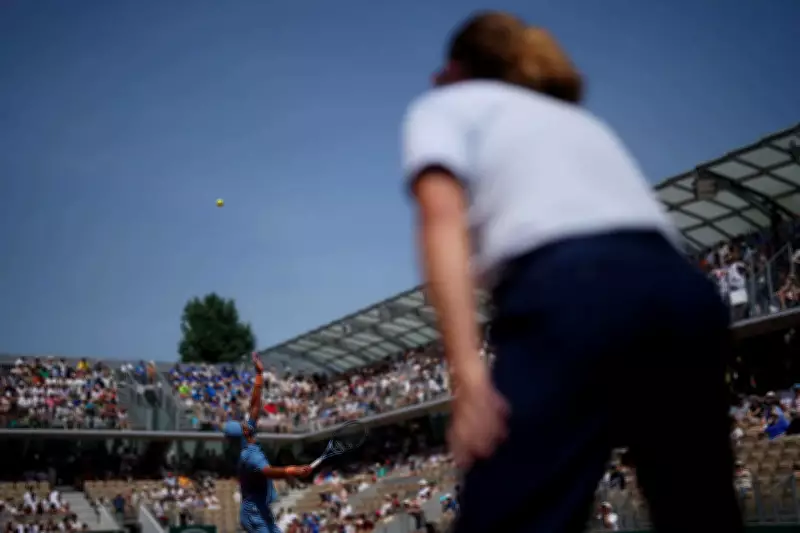
Extreme temperatures at the 2026 French Open sparked growing concern among players on Wednesday after Jakub Mensik collapsed on court following a draining five-set victory, while Novak Djokovic suggested tournament organisers may eventually need to reconsider match scheduling during severe heatwaves. Paris temperatures climbed into the mid-30s Celsius as conditions at Roland Garros became increasingly difficult for players competing in lengthy matches under direct sunlight.
Mensik's Ordeal on Court
The most alarming scenes unfolded after 20-year-old Mensik defeated Mariano Navone 6-3, 2-6, 6-4, 1-6, 7-6 (13-11) in a second-round battle lasting four hours and 41 minutes. The Czech player, seeded 26th in the tournament, struggled physically throughout the closing stages and needed eight match points before finally securing victory. Moments after striking the winning shot, Mensik collapsed onto the clay while overcome by exhaustion, cramp and emotion.
Argentina's Mariano Navone immediately crossed the net to congratulate and help Mensik, but quickly realised the Czech player could barely move. Medical staff rushed onto the court and treated Mensik while he remained on the ground for several minutes. Ice packs were placed on his head, neck and chest in an attempt to lower his body temperature, while another ice pack was positioned beneath his head like a pillow. Although Mensik eventually managed to stand with assistance and struggled while walking toward the locker room, he ultimately mustered the strength to walk out himself as he did not want to leave the court in a wheelchair.

The 20-year-old later revealed he had already completed an ice bath and recovery session in the gym as he began preparing for his third-round match against Alex de Minaur.
Player Reactions and Criticism
"When I hit the last winner, the emotions went out and my body just turned off," Jakub Mensik said in the post-match press conference. "It's insane to play in this weather and especially in front of the sun. To be there for more than four and a half hours is just insane." He added, "Even with the breaks, you don't have that much time. The ball kids can't bring your towel and during the changeover you have just one minute. Before you sit it's already 30 seconds and there's not that much time to cool yourself down."
Mensik was competing on one of Roland Garros' outer courts, where players receive almost no shade during daytime matches. He also expressed frustration with the strict enforcement of timing rules between points, revealing he twice lost his first serve after exceeding the time limit while attempting to recover physically. "Here it's super-strict, which I totally respect, but obviously in this heat and in these conditions it's insane," Mensik said. "The rules are rules, of course, but normally when a spectator watches, they will be like: 'OK, give him mercy, five more seconds, 10 more seconds,' which obviously I didn't have."
ATP Regulations on Cramping
ATP regulations currently state that players cannot receive a medical timeout specifically for muscle cramping because it is classified as a fitness issue rather than an injury. However, the rules also state that if tournament medical staff determine a player is suffering from heat illness, then cramping may be treated as part of the broader medical condition. The ATP rulebook states: "A player may receive treatment for muscle cramping only during the time allotted for change of ends and/or set breaks." It further adds: "If the sports physiotherapist believes that the player has heat illness, and if muscle cramping is one of the manifestations of heat illness, then the muscle cramping may only be treated as part of the recommended treatment by the Sports Physiotherapist for the heat illness condition."

Djokovic Weighs In
Djokovic also spoke about the exhausting conditions after his own physically demanding second-round victory over French wildcard Valentin Royer on Court Philippe Chatrier. The 24-time Grand Slam champion required three hours and 44 minutes to defeat Royer 6-3, 6-2, 6-7 (7-9), 6-3 despite competing on the tournament's main showcourt, which features a retractable roof. "When you play a three-and-a-half-hour match on clay, it's long and very exhausting," Djokovic said after the match. "So physically I spent quite a bit of energy today on a very hot day. Very challenging conditions."
Djokovic later suggested organisers may eventually need to consider moving matches later into the evening if extreme temperatures continue. "Is that ideal to go over midnight? Yeah, it's not," Djokovic said. "But if you have certain days that you have extreme heat and conditions, then maybe that's something to consider." The Serbian will next face Brazilian teenager João Fonseca in the third round.
Other Players Affected
Women's 15th seed Marta Kostyuk admitted conditions had become increasingly difficult throughout the opening week of the tournament. "It's still hot and it's very dry," Kostyuk said. "I always felt like I need to drink, I want to drink more and more. It was tough." Earlier in the week, former finalist Casper Ruud said he feared he was suffering from heat stroke after describing himself as "walking around like a zombie" during 33-degree conditions on Monday.
Meanwhile, second seed Alexander Zverev largely avoided the worst of the weather after playing during the night session, when temperatures dropped closer to 18 degrees Celsius. The 2024 Roland Garros runner-up defeated Tomas Machac 6-4, 6-2, 6-2 in one hour and 48 minutes as he continued his pursuit of a first Grand Slam title.
Tournament Measures
French Open organisers currently monitor conditions using wet bulb sensors positioned on Court Philippe Chatrier and Court 14. Tournament regulations allow a 10-minute heat break after the second set of women's matches and the third set of men's matches if temperature thresholds are reached. Matches can also be suspended entirely if conditions become dangerous, although no French Open match has ever been halted because of extreme heat.