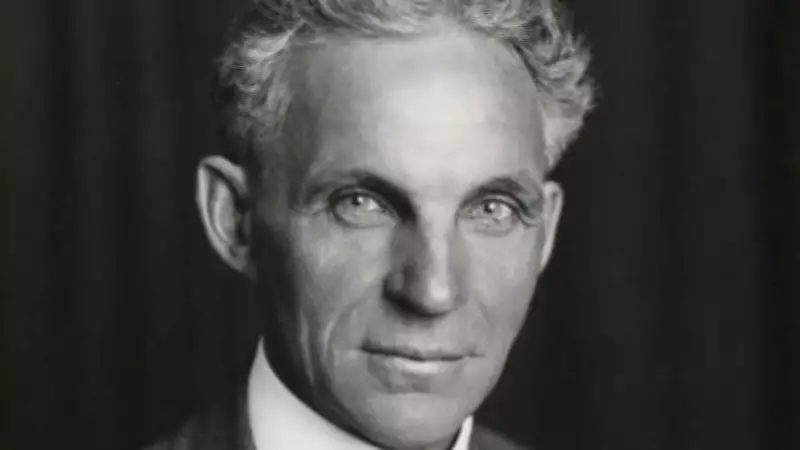
Henry Ford is remembered for the assembly line, for making the automobile affordable, and for fundamentally changing the way the world manufactures things. This quote did not come from a motivational speaker or a self-help book but from a man who started with almost nothing, taught himself the mechanics of an engine in a shed, and spent decades building on what he had learned the day before. While the line is short, its implications are not.
Quote of the day by Ford Motor Company founder Henry Ford
Anyone who stops learning is old, whether at twenty or eighty. Anyone who keeps learning stays young.
What Ford is really saying
The quote makes a distinction most people do not naturally make: between biological age and what might be called intellectual age. Biological age is fixed and moves in one direction. Intellectual age, in Ford's framing, is not fixed at all. It is determined entirely by whether a person is still learning, in other words, is the person still taking in new information, still willing to be changed by experience and still curious about things they do not yet understand.

By that measure, a twenty-five-year-old who has decided they already know what they need to know is, in a meaningful sense, old. Their thinking has closed around what they have already accumulated. New information will be filtered through existing conclusions rather than genuinely considered on its own terms.
On the contrary, a seventy-five-year-old who wakes up every morning still interested in how things work, still willing to revise what they think and still capable of being surprised is a person, by Ford's definition, who is still young in the way that matters most.
Ford’s own life as evidence
Ford did not arrive at this idea through reading philosophy but by living it. In the early decades of his career, Ford was a learner. He studied machinery, absorbed everything he could from the engineers and inventors around him, and remained genuinely open to ideas that challenged his existing assumptions. The moving assembly line did not emerge from a fixed mind but from someone who kept asking whether there was a better way to do something everyone else had accepted as settled.
The contrast between the young Ford who revolutionised manufacturing and the older Ford who resisted updating his own products is not incidental to the quote.
Why people stop learning
“Keep learning” is not the message by Ford alone, several other tech CEOs and people of clout have shared the same stance. If continuous learning is this clearly valuable, the obvious question is why so many people stop doing it. The answer is not laziness it is often success.
The person who has worked hard to develop genuine expertise in something has, by definition, invested significantly in a particular way of understanding the world. That investment creates a natural attachment. The frameworks that got you to where you are feel validated by the fact that they worked. Challenging them starts to feel like undermining yourself.
Expertise, accumulated experience, and past success can all gradually shift from assets into limitations. And this will not happen because they lose their value, but because they start to crowd out the openness that allowed them to be developed in the first place. While there is a comfort of certainty, learning requires tolerating not knowing things, sitting with confusion, and being willing to revise positions that may have been held for a long time. That is uncomfortable in ways that simply reinforcing what you already believe is not.
Why the quote still holds up
Ford made this observation decades ago when the world he inhabited was so different from the present one that direct comparisons are almost impossible. And yet the principle holds, perhaps more urgently now than it did in his time.
The pace at which knowledge changes, industries shift and skills become obsolete has accelerated dramatically. A professional today who stops learning at forty is intellectually stagnant as well as professionally vulnerable in ways that would not have applied to the same degree in Ford’s era.

The quote does not offer a technique or a methodology. It offers something more fundamental: a way of understanding what it means to be alive and engaged in the world. Ford’s argument is that the mind's vitality is not determined by age but by the choice, made repeatedly over a lifetime, to remain open to what the world still has to show you.