

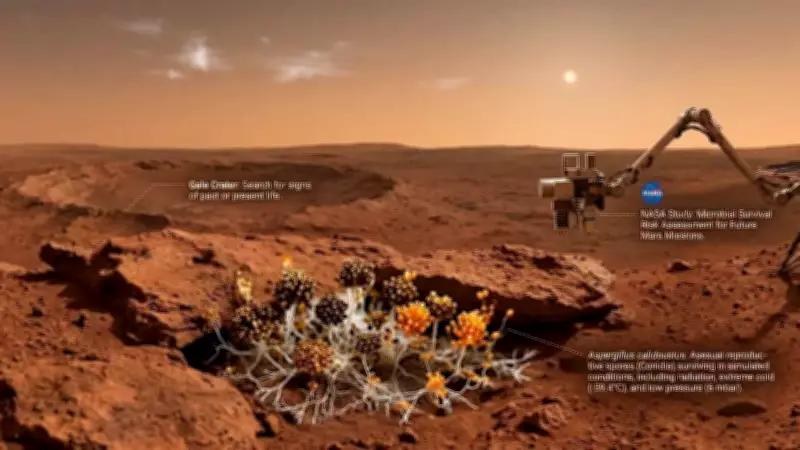
NASA Research Uncovers Fungal Resilience in Simulated Mars Environment
A groundbreaking NASA-supported research study has made a startling discovery: certain fungal spores possess the remarkable ability to survive exposure to the extreme conditions of outer space. These findings, published in the journal Applied and Environmental Microbiology, raise significant questions about the potential for microorganisms, including bacteria and fungi, to endure during future missions to Mars and beyond.
Aspergillus Calidoustus: Earth's Fungi Defying Mars-Like Extremes
The research focused on Aspergillus calidoustus, a fungal species whose spores were collected from spacecraft assembly cleanrooms. Scientists subjected these conidia (asexually produced spores) to meticulously simulated Mars-like conditions over an extended period of up to 1.5 years. The harsh environment included:
- High doses of ultraviolet radiation
- Extremely low barometric pressure (6 mbar)
- Freezing temperatures comparable to Martian climate
- Exposure to Martian regolith (soil)
Remarkably, these fungal spores survived conditions previously considered sterilizing, including long-term neutron radiation exposure and standard dry heat microbial reduction procedures. This resilience challenges existing assumptions about microbial survivability in space environments.

Planetary Protection Protocols Face New Challenges
While this study provides no evidence of current contamination on Mars, it highlights a critical flaw in existing planetary protection protocols. Current standards primarily focus on eliminating bacterial spores, which have traditionally been the main target of decontamination efforts due to their known durability.
However, this research demonstrates that eukaryotic organisms like fungi, which have complex cellular structures including a nucleus, possess different survival mechanisms that may render current decontamination procedures inadequate. Even highly controlled cleanrooms can harbor these resilient fungal spores, creating potential contamination risks for robotic systems destined for other planets.
The Outer Space Treaty and Biological Integrity Concerns
The ability of Earth-originating microorganisms to survive on Mars presents a significant hurdle for future exploration missions, particularly those seeking evidence of extraterrestrial life. NASA's policy, established under the 1967 Outer Space Treaty, mandates that all space exploration must prevent 'forward contamination' to protect the biological integrity of other celestial bodies.
The discovery that Aspergillus calidoustus can withstand various combinations of space-relevant environmental conditions is now being used to improve risk assessment accuracy for potential Mars contamination by Earth-sent landers and rovers. Experts emphasize that understanding the 'synergistic effects' of combined space environmental factors—radiation, extreme cold, low pressure—is essential to ensuring future missions don't inadvertently alter Martian ecosystems.
Implications for Future Space Exploration
As humanity prepares for deeper cosmic exploration, this study underscores the urgent need to expand planetary protection regulations to include eukaryotic organisms alongside bacteria. The research team urges space agencies worldwide to reconsider decontamination standards and develop more comprehensive protocols that account for fungal resilience.
This NASA-supported investigation represents a crucial step toward safeguarding the scientific integrity of future Mars missions while advancing our understanding of microbial life's extraordinary adaptability in extreme environments.






