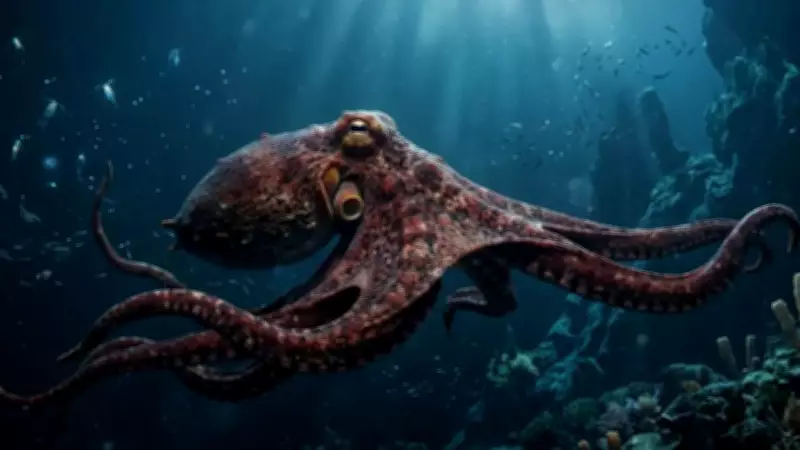
Fossil evidence suggests there were real 'Kraken' – finned octopuses who fed on large animals at the top of the food chain – in ancient Cretaceous oceans, say scientists at Hokkaido University in Japan. They have published their study on prehistoric Cephalopods (a group that includes octopuses, squid, cuttlefish, etc.) in the journal Science.
Through high-resolution grinding tomography combined with machine learning, the researchers were able to identify beak fossil remains from extinct cephalopods that had fins and measured up to 7-19 meters long. These creatures occupied the top position in food webs of all other marine organisms, including vertebrates like mosasaurs and sharks. The cephalopods also used their very hard beaks as crushing tools to kill prey; prey can include crustaceans, bony fish (including tooth-like structures), bony predatory fish, and animals living on the ocean floor.
Fossil discovery shows 60-foot Octopuses as the apex predators millions of years ago
The discovery of Nanaimoteuthis jeletzkyi has changed what we know about the evolution of cephalopods. Scientists used the size of the chitinous beaks (the only hard part of a cephalopod's body) to help them figure out how large these cephalopods would have been. The results show that they are much larger than the largest living cephalopods, the giant squids, as noted in the Science journal. The evidence shows that these cephalopods were not only passive drifters, but also very active and powerful predators of the largest marine reptiles alive at the time.

Evidence of apex predation and advanced cognitive behaviour
The researchers found heavy-duty wear patterns on the fossilised beaks (i.e., chipped/scratched/etc), and they found some specimens where 10 per cent of the beak tip was worn away. This amount of wear is consistent with cephalopods crushing and eating very hard-shelled organisms, as well as bony organisms. The researchers also noted that the wear pattern on some of the beaks was asymmetric. So, the researchers feel this indicates that these cephalopods had a lateralized preference for which direction they used to accomplish certain tasks. Therefore, along with their size and hunting strategies, they show evidence of having advanced cognitive abilities similar to modern intelligent cephalopods.
Digital three-dimensional revealed a hidden 60-foot predator
Due to the rarity of fossilised remains from soft-bodied organisms such as octopuses, these samples have been covered in rock concretions for millions of years. The scientists used an innovative method called 'digital fossil-mining,' utilising high-resolution grinding tomography to expose the jaws internally via a combination of AI-facilitated 3D reconstruction. According to the Science journal, their results confirmed that these 60-foot-long creatures existed, as well as extending the known evolutionary record for finned octopuses by 15 million years and the broader octopus record by 5 million years.