

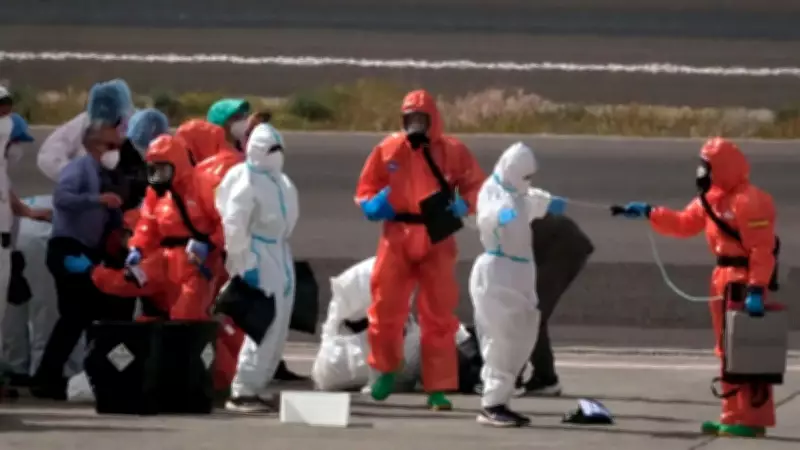
The hantavirus outbreak linked to the MV Hondius cruise ship has now surpassed 10 global cases, sparking public anxiety and comparisons to COVID-19. Quarantines and monitoring continue across Europe, North America, Canada, and Australia, while online searches for hantavirus symptoms and fatality rates have surged. However, the World Health Organization (WHO) has stepped in to clarify the nature of this outbreak.
WHO's Verdict on the Hantavirus Outbreak
Top WHO epidemiologist Maria Van Kerkhove addressed concerns during a briefing this week, as reported by The Telegraph. She emphasized that while the outbreak is serious and warrants close observation, it is not COVID-19 or bird flu. The initial cluster of cases among passengers who had been bird-watching in Argentina initially raised fears of avian influenza, but laboratory tests in South Africa ruled out bird flu and legionnaire's disease, confirming Andes hantavirus instead.
Van Kerkhove expressed relief that it was not a zoonotic influenza, stating, 'It's strange but yes, I was relieved that it wasn't a zoonotic influenza, because of the link with the first three cases. If it had turned out to be a zoonotic influenza, and we already knew there were three cases epidemiologically linked, that would have been a bit more concerning.'

Nevertheless, with a high fatality rate and potential for person-to-person transmission, she described this as a 'make or break' stage for the response. There is currently no vaccine or specific treatment for Andes hantavirus, which can have a fatality rate of up to 50%. It is the only hantavirus known to spread between humans, including through 'super spreader' events. On the cruise, 11 people were infected, and three died.
Global Response and Quarantine Efforts
As of now, 88 passengers and 59 crew members from 23 countries have disembarked in Tenerife, Spain. Approximately 30 others who left the MV Hondius early have also been located. Van Kerkhove noted, 'The challenge right now is how the quarantine unfolds. This is a critical period.' Since the WHO was alerted to the outbreak on May 2 by UK officials, a global public health response has been underway.
The WHO advises anyone exposed to undergo 42 days of quarantine or self-isolation, with regular testing and medical care. Most symptoms appear within two weeks, though the incubation period can extend up to six to eight weeks. Van Kerkhove acknowledged that more positive cases may emerge due to rigorous testing among known contacts, but clarified that this does not necessarily indicate an expanding outbreak. She expressed concern about a woman in France currently in intensive care, while other patients are improving.
International Collaboration
Van Kerkhove praised the global response, noting that the outbreak has tested pandemic systems and fostered cooperation among countries. Laboratories in Argentina, South Africa, Senegal, the Netherlands, and Switzerland have conducted tests and sequencing. Spain facilitated safe disembarkation in Tenerife. Despite political tensions, such as the United States' exit from the WHO, information sharing has continued.
'No one cares about politics,' she said. 'We have a common goal: stop the outbreak. We don't want a repeat of Covid, and this was never going to be that kind of repeat.'
Precautionary Approach and Research
The WHO has avoided labeling this the next pandemic, learning from early COVID-19 messaging. Van Kerkhove emphasized the importance of speaking with nuance about uncertainty. Everyone from the ship was considered high-risk from the start. Scientists are still investigating how the Dutch couple contracted Andes hantavirus, with theories shifting from bird-watching near a rubbish dump in Ushuaia to rodent sampling along their travel route.
The virus is listed as a research priority, and the crisis may drive investment in diagnostics, therapies, and vaccines. However, Van Kerkhove's primary concern remains respiratory diseases like influenza and coronaviruses, as well as arboviruses such as dengue and Zika, which are expanding into new regions due to climate change.
She noted that diseases like hantavirus, Ebola, and Marburg tend to be self-limiting due to inefficient transmission, despite causing significant damage when they occur. They do not possess the pandemic potential of COVID-19 or influenza.

As the world watches, the coordinated international response aims to contain the outbreak. Whether it fizzles out or leads to further cases remains to be seen, but for now, global health authorities are holding the line.





