For almost two centuries, this plant was more of a rumor than a reality. Botanists knew it used to exist, as old 19th-century records talked about it, and faded herbarium sheets held bits and pieces. But nobody could tell you where it had gone. Had it vanished for good? Was it hiding somewhere in the Himalayas that nobody had checked? Or was it just waiting for someone determined enough to stumble upon it?
Well, the wait is over. After 188 years, researchers have rediscovered the legendary Himalayan blueberry in the forests of Arunachal Pradesh. It is hard to overstate how big this is in the world of Indian botany. The plant turns out to be Vaccinium piliferum: a rare, endangered cousin of our usual blueberries and cranberries that had not had a proper scientific sighting since 1836.
So, why does everyone, from scientists to local berry-lovers, feel like celebrating? Because let us face it, how often does a plant pull off the ultimate game of hide-and-seek for almost 200 years and then suddenly show up in a global biodiversity hotspot?

Where did the discovery take place?
According to Arunachal Times, this all happened in Vijaynagar, deep in the forests of Changlang district, Arunachal Pradesh. Scientists from the Society for Education and Environmental Development (SEED), CSIR-North East Institute of Science and Technology (CSIR-NEIST), and a few other research groups found the plant during one of their field trips in the Eastern Himalayas. Their findings were later published in the scientific journal Feddes Repertorium.
But before you imagine wild blueberries carpeting the hillsides, here is what actually makes this species stand out.
What is the Himalayan blueberry?
Think of Vaccinium piliferum as a wild relative of the familiar supermarket blueberry. It belongs to the same big family (Ericaceae) that includes cranberries, bilberries, and rhododendrons. But do not expect exactly the same fruit you pop into your cereal.
The plant is a climbing shrub, reaching close to 4.5 meters. So it is not hugging the ground like typical berry bushes. It twines through forest trees, sometimes even growing as an epiphyte (which means it sets up shop on other plants without hurting them). That is a detail scientists had not properly documented before seeing it in its natural element.
What does it look like?
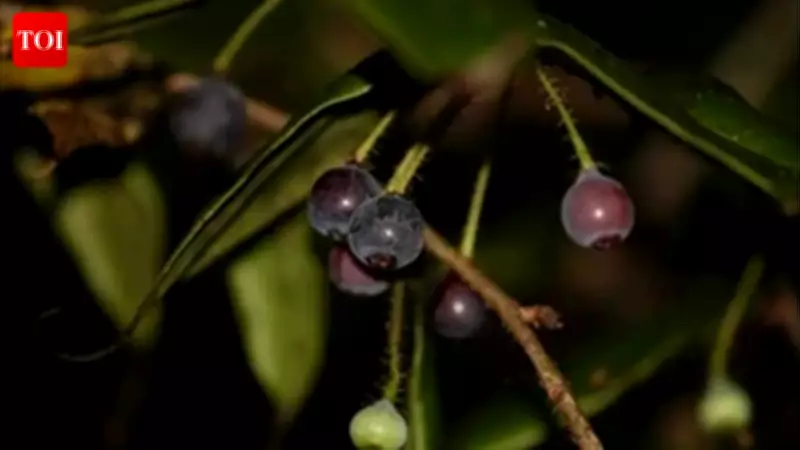
In a word, it is enchanting. The plant blooms with soft, pale green, bell-shaped flowers that dangle from the branches. The leaves sometimes have a reddish edge, which brings a splash of color that stands out in all that green. And then, there are the berries themselves.
Dark purple, with a cool, bluish-white waxy layer — these berries look like they walked out of a painting. They are clearly in the blueberry club, though researchers say they do have a few quirks that make them unique.
What about the taste?
Nobody has released an official tasting report yet, so gourmet descriptions will have to wait for now. Still, since Vaccinium piliferum is related to both blueberries and cranberries, experts think the flavor hits that familiar sweet-tart balance. You should know: local communities in the area have been eating these berries for generations. They seem to think the fruit is both tasty and safe.
People there even call these berries a natural energy boost. Some compare them, half joking and half serious, to the “Sanjeevani Booti” of Indian legends. No, that is not hard science, but it is enough to stoke curiosity.
Are there health benefits?
So far, nobody has run detailed nutritional or medicinal tests on Vaccinium piliferum. However, you must stay tuned, as no one is ready to make big health claims. But if you go by its close relatives, blueberries and cranberries are packed with antioxidants (especially anthocyanins, the stuff that gives them their color). These compounds are known for fighting inflammation, protecting your heart, and guarding your cells from damage. That is why researchers are keen to see if the Himalayan blueberry offers the same perks.
For now, it is all in the “promising, but let us see” category.

About the Author
The TOI Lifestyle Desk is a dynamic team of dedicated journalists who, with unwavering passion and commitment, sift through the pulse of the nation to curate a vibrant tapestry of lifestyle news for The Times of India readers. At the TOI Lifestyle Desk, we go beyond the obvious, delving into the extraordinary. Consider us your lifestyle companion, providing a daily dose of inspiration and information. Whether you are seeking the latest fashion trends, travel escapades, culinary delights, or wellness tips, the TOI Lifestyle Desk is your one-stop destination for an enriching lifestyle experience.