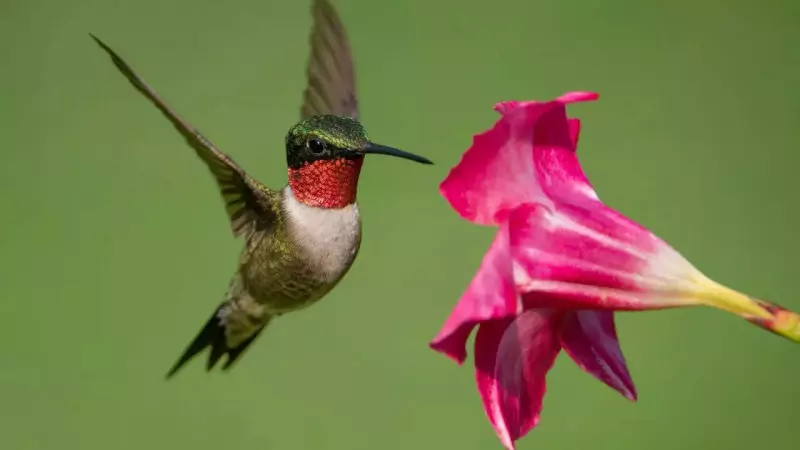
Hummingbirds stand out in the avian world for their extraordinary capabilities, with backward flying being one of their most remarkable traits. Unlike most bird species, which primarily rely on forward motion, hummingbirds can hover, fly upside down, sideways, and even backwards with incredible precision. This ability is not merely a display of agility but a crucial adaptation rooted in their unique anatomy and flight mechanics, allowing them to navigate flowers and feeders efficiently for feeding.
The Science Behind Backward Flight
According to a study titled "Backward flight in hummingbirds employs unique kinematic adjustments and entails low metabolic cost," published in PubMed Central, hummingbirds achieve backward flight through several key factors. These include specialized wing motions, anatomical features, and energy-efficient strategies that have evolved over millions of years.
Unique Wing Motion and Anatomy
Hummingbirds flap their wings in a distinctive figure-eight pattern, unlike other birds that generate lift mostly on the downstroke. This pattern enables them to produce lift on both the upstroke and downstroke, facilitating hovering and instant directional changes. Their wings rotate at the shoulder joint, functioning similarly to helicopter blades for multi-directional control.

Specialized shoulder and muscle anatomy further enhance their flight capabilities. Hummingbirds have evolved flexible shoulders and powerful muscles, with wing muscles accounting for nearly a third of their body weight. Ball-and-socket shoulder joints provide a 360-degree range of motion, allowing for backward, forward, and sideways flight. Additionally, their lightweight skeletons reduce the energy required for midair manoeuvres.
Energy-Efficient Flight Mechanics
Contrary to expectations, backward flight does not consume excessive energy. Kinematic adjustments allow hummingbirds to move backwards with a surprisingly low metabolic cost. By synchronizing their precise wing strokes, they conserve energy while maintaining control and speed. This efficiency is vital, as hummingbirds need to feed frequently, particularly on nectar, to sustain their high-energy lifestyles.
Feeding and Survival Adaptations
Backward flight plays a significant role in feeding, enabling hummingbirds to exit flowers safely without losing balance. It allows them to hover near nectar sources and access food with precision. Beyond feeding, this ability serves as a survival strategy, helping them quickly evade predators without turning around and navigate through tight spaces, branches, and leaves with ease.
Evolutionary Advantage and Mating Displays
The ability to fly backwards is a result of millions of years of evolution, giving hummingbirds a competitive edge in habitats where other birds struggle to access nectar. This unique skill makes them one of the most specialized and adaptive bird species globally. During mating seasons, hummingbirds showcase acrobatic flying skills, including backward flight, to impress mates and demonstrate balance in the air, highlighting the multifaceted benefits of this adaptation.
From a scientific and natural-history perspective, hummingbirds exemplify how specialized adaptations in the animal world can extend far beyond human imagination, reminding us of the wonders of evolutionary biology.