The conflict in Ukraine has been widely recognized for the use of drones in air and sea operations against Russia. However, over the past two years, Kyiv has transitioned from experimental deployments to fielding thousands of Unmanned Ground Vehicles (UGVs). These uncrewed systems now handle roles such as combat, logistics, engineering, and explosive disposal. Some are even used as kamikaze robots, driving explosives into Russian positions. These machines operate in mud, snow, and under constant fire, proving their resilience in extreme conditions.
Operational Concept and Impact
The operational concept is not to replace soldiers but to keep them out of kill zones. According to Ukraine's General Staff, robotic platforms have reduced casualties by up to 30% in some instances. This has helped preserve manpower for offensive operations and slowing force attrition, as reported by a US Army-run think tank.
Classification of UGVs
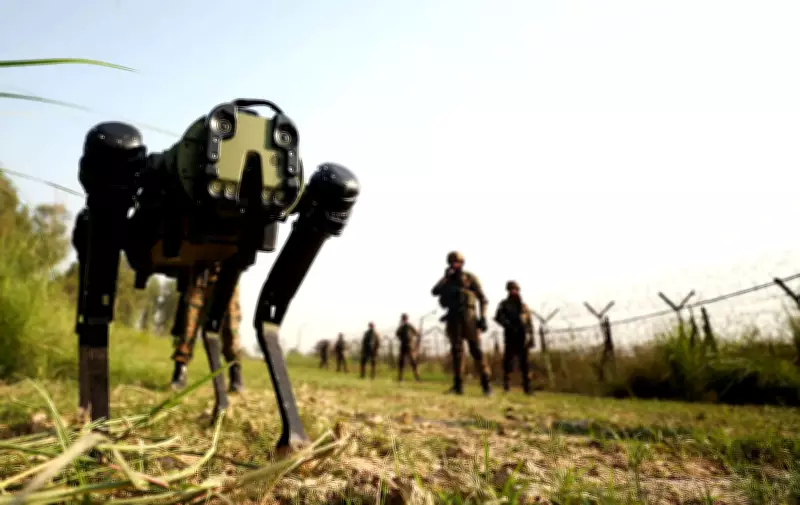
UGVs lack a universal classification but can be distinguished by armament, size, weight, and locomotion type. They range from small handheld devices to large, tank-sized platforms. Locomotion is a key differentiator. Wheeled systems are power-efficient but less effective off-road. Tracked systems excel in rough terrain but are noisy, consume more energy, and move slowly. Legged systems, such as robotic dogs and mules, can navigate uneven terrain well but are mechanically complex, slower, and require more power. Legged models are generally smaller compared to wheeled and tracked variants, according to the UN Institute for Disarmament Research (UNIDIR).

Ukraine's Ambitious Expansion
As the torchbearer of unmanned systems, Ukraine plans to contract 25,000 unmanned ground vehicles in the first half of 2026, more than double the 2025 total, as the Defense Ministry moves to shift all frontline logistics off soldiers and onto robots, according to the Ukrainian defence ministry.
India's Robotic Advancements
The Indian Army is also embracing robotics to enhance combat readiness, logistics, and border security. Robotic mules, deployed on the Line of Control (LoC) as per an Economic Times report, are quadrupedal machines capable of carrying supplies and ammunition across snow, deserts, and rugged terrain. They can also detect explosives and conduct reconnaissance, reducing risks for soldiers in hazardous zones.
DRDO's Humanoid Robots
Parallelly, the Defence Research and Development Organisation's (DRDO) Centre for Systems and Technologies for Advanced Robotics is developing humanoid robots with advanced mobility and manipulation features, including 24 degrees of freedom arms and AI-driven navigation, according to an Economic Times report. These robots are being designed to handle improvised explosive devices, nuclear-biological-chemical threats, and other high-risk missions.
About the Author: The TOI News Desk comprises a dedicated and tireless team of journalists who operate around the clock to deliver the most current and comprehensive news and updates to readers of The Times of India worldwide. With an unwavering commitment to excellence in journalism, our team is at the forefront of gathering, verifying, and presenting breaking news, in-depth analysis, and insightful reports on a wide range of topics. The TOI News Desk is your trusted source for staying informed and connected to the ever-evolving global landscape, ensuring that our readers are equipped with the latest developments that matter most.