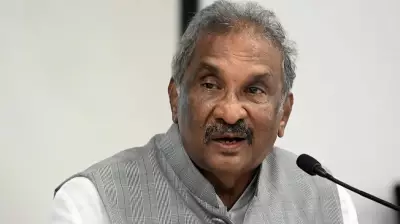
India Surpasses US in AI Data Contribution, Says Former NITI Aayog CEO
In a significant revelation at the India AI Summit 2026, former NITI Aayog CEO and G20 Sherpa Amitabh Kant stated that India is contributing substantially more data to artificial intelligence development than the United States. Kant emphasized that this data advantage must translate into tangible benefits for the Global South through inclusive AI models.
Data Dominance and the Call for Local AI Models
"If you examine platforms like Open AI and ChatGPT, we are providing 33% more data than the United States of America," Kant declared during his summit address. "These large language models are improving primarily through data sourced from the Global South. It is crucial that this contribution results in advantages for these regions."
The former bureaucrat urged India to develop its own AI frameworks to capitalize on this data contribution. He warned that without proper Digital Public Infrastructure (DPI), the world risks creating profoundly unequal societies where AI benefits remain concentrated among a privileged few.

Three Pillars for Responsible AI Evolution
Kant outlined three fundamental principles that must guide artificial intelligence development:
- Accessibility: Ensuring AI tools reach all segments of society
- Affordability: Making AI solutions economically viable for diverse populations
- Accountability: Establishing clear responsibility frameworks for AI systems
He highlighted a critical disparity in how large language models are currently trained, noting that while the Global South serves as the engine room for AI development through data provision, the benefits often flow elsewhere.
Beyond English-Centric Models: The Multilingual Imperative
Kant argued that for artificial intelligence to be truly inclusive, it must transcend English-centric limitations and become natively multilingual. "AI must evolve to serve diverse populations in their native languages," he emphasized, pointing to India's linguistic diversity as both a challenge and opportunity for AI development.
Digital Public Infrastructure: The Blueprint for Inclusive AI
Drawing parallels with India's successful financial inclusion initiatives, Kant proposed that AI should follow the blueprint of India's Digital Public Infrastructure. DPI represents an open, interoperable digital framework for identity verification, payments, and data exchange that enables governments to deliver secure, accessible public services at scale.
"Our digital ecosystem succeeded because our models were open-sourced," Kant explained. "My perspective is that AI requires a foundational layer of digital public identity, upon which private sector innovation can flourish through healthy competition."
He noted that India's DPI approach enabled the country to achieve decades of development progress within just seven years, suggesting similar acceleration could occur with properly structured AI frameworks.
Addressing Grassroots Challenges Through AI
During the session titled "AI for India's Next Billion: Intergenerational Insights for Inclusive and Future-Ready Growth," Kant elaborated on how social transformation could be achieved by deploying artificial intelligence to solve fundamental problems in healthcare, education, and agriculture.
Other distinguished panelists included Amandeep Singh Gill from the United Nations, Arunabha Ghosh of CEEW, Claire Melamed and Kunalika Gautam from the UN Foundation, Ruchira Goyal of Sustainable Food Systems, and Safiya Husain of Karya.
Warning Against AI-Driven Inequality
Reflecting on post-World War 2 economic patterns in Western nations, Kant cautioned that technological progress doesn't automatically guarantee equity. He expressed concern that current trajectories of massive AI investment could create "a highly unequal society" if technology remains controlled by limited entities.
"If we ultimately create an unequal society through AI development, we have fundamentally failed," Kant asserted. "Our objective must focus on transforming citizens' lives in the Global South rather than merely boosting valuations of large technology corporations."

The former NITI Aayog CEO's remarks underscore growing global conversations about equitable AI development, data sovereignty, and the need for frameworks that ensure technological advances benefit all humanity rather than concentrating advantages among technologically advanced nations and corporations.