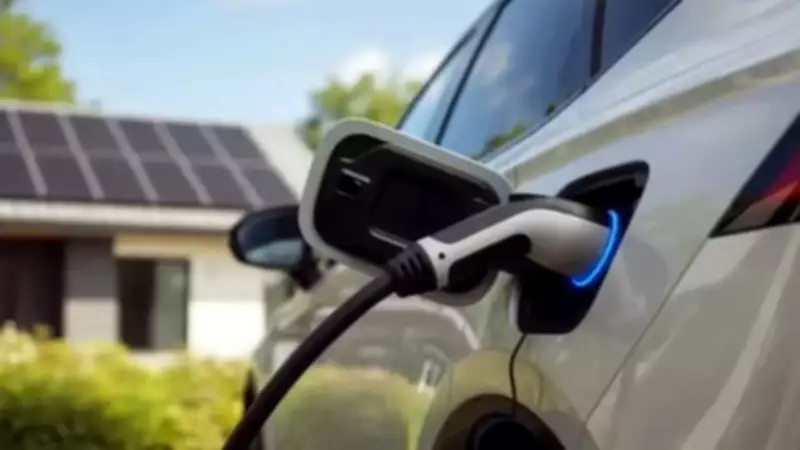
India's electric vehicle (EV) story appears successful on the surface, with public charging stations growing nearly sixfold in under three years and EV sales increasing by 19% over the prior year. The government has committed ₹10,900 crore under PM E-DRIVE to accelerate the transition. However, a recent Observer Research Foundation report reveals that India's EV-to-charger ratio stands at 1:235, against a global benchmark of 6 to 20, and 38% of EV users still cite unreliable charging as a major barrier to adoption. These numbers indicate a problem of charging reliability rather than adoption.
The Performance Gap Nobody Is Measuring
When a fast charger rated at 60 kW operates on a 46°C afternoon in Delhi, it typically delivers only 38-42 kW. Most fast chargers in the mid-market segment use silicon IGBT (Insulated Gate Bipolar Transistor) architecture, a mature technology optimized for cooler climates in Europe, East Asia, and North America, where peak summer temperatures rarely exceed 35°C. In India, where ambient temperatures climb to 45-50°C from March through June, these systems approach thermal design limits. The engineering response is thermal derating: output power is reduced automatically to protect components. The charger remains on, but a 60 kW session becomes a 38-42 kW session, unbeknownst to the driver, operator, or fleet manager.
This is not a fringe problem but a structural one. India is building the foundation for future volumes required to hit 30% private car EV penetration and 80% two- and three-wheeler penetration by 2030. The current 27,000 stations are just the beginning.

A Design Flaw, Not a Maintenance Failure
Charging reliability is often framed as a maintenance problem, but thermal derating is not a maintenance failure. A charger that derates during a heatwave in Rajasthan is doing exactly what it was designed to do in conditions it was never designed for. The real question is what technology foundation is appropriate for India's climate.
Silicon IGBTs have inherent limitations in high-ambient environments. As junction temperatures rise, switching losses increase, generating more internal heat, which further raises temperatures. Silicon Carbide (SiC) MOSFET architecture addresses this at the source. SiC MOSFETs achieve system efficiencies of up to 98.5%, compared to approximately 96% for conventional IGBT designs. In a 60 kW IGBT-based charger, roughly 2.4 kW is lost as heat during operation; in a SiC-based equivalent, that drops to under 900 W, a 60% reduction. In Indian summers, where outdoor temperatures regularly exceed 45°C, this difference is decisive. Less internal heat means cooling systems are under less strain, components run further below thermal limits, and the system has more headroom before throttling output.
The practical implications for SiC MOSFETs in Indian operating environments include maintained rated output regardless of ambient temperature, with SiC-based chargers designed for Indian conditions sustaining rated power delivery at 55°C ambient. Lower internal thermal load reduces switching losses, lowering the burden on cooling mechanisms, extending component life, and improving long-term reliability. Greater headroom before protective throttling means the system operates further below its thermal ceiling under normal conditions.
What 'Climate-Ready' Infrastructure Actually Means
Deploying climate-ready EV charging infrastructure requires designing for the operating conditions normal in India, not treating them as edge cases. This involves specifying for real operating conditions by evolving procurement frameworks to include thermal derating curves and rated output at 45°C and 50°C ambient. Building thermal performance into station economics means operators need accurate performance data across the full temperature range their stations will experience. Treating uptime and delivered performance as separate metrics is crucial: a charger that is powered on and physically available but delivering 60% of rated output is partially offline for practical purposes.

The Bigger Picture
India's EV transition is one of the most consequential infrastructure programmes underway anywhere. The targets to achieve 70% EV penetration for commercial vehicles, 30% for private cars, and 80% for two- and three-wheelers by 2030 require not just deploying chargers at scale, but deploying chargers that work reliably under real Indian conditions at scale. The industry has made extraordinary progress on deployment velocity. The next phase of maturity is about deployment quality: ensuring that what gets built actually performs as intended in May and June as reliably as in November and December, on a highway corridor in Rajasthan as dependably as in a climate-controlled parking structure in Bengaluru. That is the infrastructure India's EV transition deserves, and it is entirely achievable with the right engineering choices made now, before the network is ten times larger than it is today.