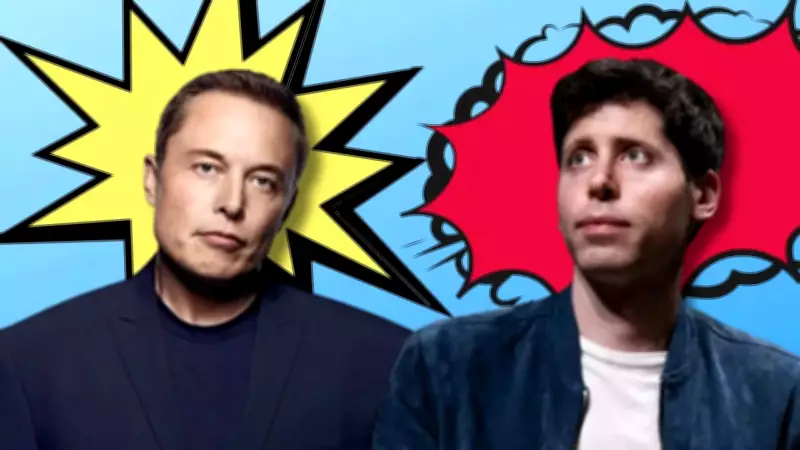
Judge Expresses Doubts Over Musk's $134 Billion OpenAI Damages Claim
In a significant pre-trial development, the judge overseeing Elon Musk's high-stakes lawsuit against OpenAI and Microsoft has voiced serious skepticism regarding the billionaire's damages calculation. However, in a crucial decision, she has declined to dismiss the evidence, paving the way for a jury trial to commence as scheduled on April 28.
"Pulling Numbers Out of the Air": Judicial Scrutiny Intensifies
The assessment emerged during a pre-trial hearing on Friday before Judge Yvonne Gonzalez Rogers in the Northern District of California. OpenAI's legal team had aggressively moved to exclude the testimony of Musk's key damages expert, C. Paul Wazzan, an economist from the Berkeley Research Group, before the trial could even begin.
According to a detailed report by The Financial Times, Judge Rogers did not mince words in her evaluation of the damages analysis presented. "A jury is going to understand that [Musk's expert] is pulling these numbers out of the air," she stated bluntly during the hearing. She further elaborated, "Do I find it convincing? Not really. Based on what I've seen, do I find it particularly persuasive? Not really."

Despite Reservations, Judge Allows Evidence to Stand
Despite these pointed reservations, Judge Rogers ultimately denied OpenAI's motion to exclude Wazzan's testimony. She expressed reluctance to make such a consequential ruling based on what she described as "a five-page motion." The judge underscored the gravity of the decision by noting, "If I agreed to OpenAI's motion to exclude Musk's expert, this trial is done, because they have no evidence of damages, right?"
This ruling ensures that the core dispute over the astronomical $134 billion damages figure will be presented to a jury. The claim is bifurcated, with $109 billion sought from OpenAI and an additional $25 billion from Microsoft.
The Heart of Musk's Legal Battle: Allegations of Fraud
Elon Musk's lawsuit alleges that OpenAI and its CEO, Sam Altman, engaged in fraud by abandoning the company's original founding mission as a non-profit artificial intelligence research organization. Musk, who co-founded OpenAI in 2015 alongside Altman and others, provided substantial early funding and support. He departed from the board in 2018 following a reported clash with Altman.
Since Musk's exit, OpenAI has transformed into one of the world's most valuable entities, with its for-profit arm recently valued at a staggering $730 billion. Musk's legal action contends this shift represents a fundamental betrayal of the initial non-profit, open-source ethos.
OpenAI's Counterarguments and Legal Strategy
During the hearing, OpenAI's legal counsel, William Savitt, launched a direct challenge against the methodology employed by Musk's expert witness. Savitt argued there was "no equation" by which Wazzan had actually arrived at his multi-billion dollar conclusions, questioning whether the analysis met the basic legal standards required for expert testimony in a court of law.
OpenAI has consistently framed the lawsuit as being driven by commercial motives rather than principle. The company has accused Musk of leveraging litigation as a tool of competition and described his legal campaign as part of "an ongoing pattern of harassment."
The stage is now set for a dramatic jury trial in late April, where a panel of citizens will be tasked with evaluating the credibility of the $134 billion damages claim and the broader allegations of fraud at the heart of this landmark technology industry dispute.