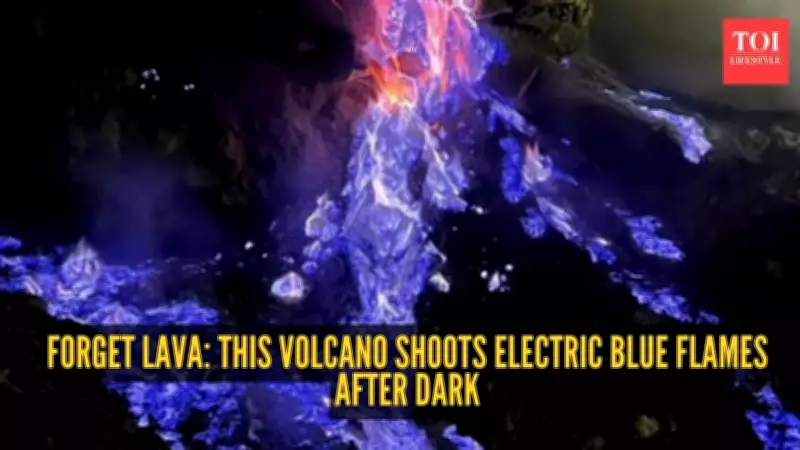
If you ever find yourself near Kawah Ijen after sunset, forget everything you think you know about volcanoes. There is no dramatic red lava flowing down the sides. No fiery orange glow lighting up the sky. Instead, you will see streaks of bright, almost neon blue cutting through the darkness. For a second, it really does feel like your eyes are playing tricks on you.
What Causes the Blue Fire?
At first glance, it looks like blue lava. That is what most people think. But the reality is a little different and honestly, even more interesting. What is actually happening here is all about gas. Kawah Ijen releases a huge amount of sulphur-rich gas from deep cracks in the ground. This is not just warm air; it is ridiculously hot, sometimes going above 600 degrees Celsius. The moment it comes out and hits oxygen, it catches fire. That is the magic behind the blue fire phenomenon.
When sulphur burns at those temperatures, the flames turn a sharp, electric blue. Because it is dark at night, you can see it clearly: flickering, glowing, sometimes even trailing down the rocks. From far away, it really does look like blue lava slowly flowing downhill. But up close, it is actually burning gas creating that effect.

Day vs. Night: A Striking Contrast
Now here is the strange part: if you visit the same place during the day, it almost feels normal. The blue flames are barely visible, and the whole area just looks like a rough, dusty volcanic crater. Nothing dramatic. Nothing that hints at what happens there at night. It is only after sunset that everything changes and the place turns into something straight out of a sci-fi film.
More Than Just Visuals: The Acidic Lake and Miners
But there is more to Kawah Ijen than just the visuals. Right in the middle of the crater sits a huge acidic lake. The water is a striking turquoise shade, almost beautiful, but it is highly corrosive and dangerous. And then there are the sulphur miners. Every single day, people work here in these conditions. They climb up and down the crater, break solid sulphur by hand, and carry heavy loads back. No machines, no easy routes, just raw effort. It is tough, risky work, and it adds a very real, very human side to a place that otherwise feels almost unreal.
That contrast stays with you. On one hand, you have this rare blue fire lighting up the night in the most surreal way. On the other, you have people working in one of the harshest environments imaginable. Maybe that is what makes Kawah Ijen so unforgettable. It flips the usual image of a volcano completely. No red lava, no familiar glow, just electric blue flames moving through the dark. It is a reminder that nature does not always follow the version we have in our heads. Sometimes, it surprises you in ways you did not even know were possible. And once you have seen something like this, even if it is just in a video, it sticks with you.