Oxford Study Traces Kissing's Origins to Ancient Apes 21 Million Years Ago
Imagine two ancient apes in a lush African forest, gently pressing their mouths together not for romance but as a primal social bond. Fast forward 21 million years, and that simple act has transformed into the intimate kisses we cherish today. A groundbreaking study from the University of Oxford, published in the journal Evolution and Human Behaviour, uses advanced statistical methods to trace the origins of kissing back to our shared ancestor with great apes, dating between 16.9 and 21.5 million years ago. This research challenges the notion that kissing is a purely modern human habit, revealing its deep evolutionary roots that span across species.
How Scientists Decoded the Origin of Kissing Using Primate Behavior
Oxford evolutionary biologist Matilda Brindle led the effort to crack the kissing code by analyzing primate family trees and employing statistical wizardry. She defined kissing simply as non-aggressive mouth-to-mouth contact, excluding food swapping. Observations show that bonobos engage in sensual smooching, while chimpanzees keep their kisses quick and tense. Gorillas and orangutans also participate in this behavior, indicating a widespread trait among great apes.
Using Bayesian models that ran simulations 10 million times, the study pinpointed the emergence of kissing to 16.9-21.5 million years ago, shortly after the evolutionary split from gibbons. "This is the first time anyone has taken a broad evolutionary lens to examine kissing," Brindle stated. "Our findings add to a growing body of work highlighting the remarkable diversity of sexual behaviors exhibited by our primate cousins." Professor Stuart West, her co-author at Oxford, praised the methodology, noting that it allows for informed inferences about traits like kissing that do not fossilize.

Neanderthals Kissed Too: 84% Probability Confirmed
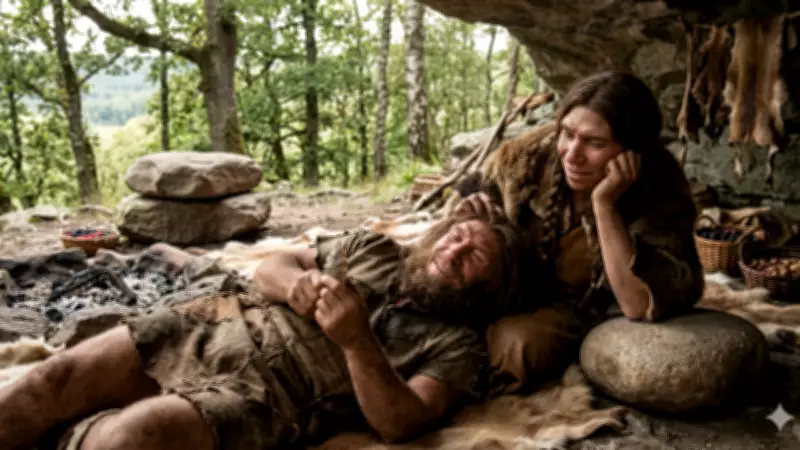
As detailed in the journal Nature, the study also provides strong evidence that Neanderthals, our robust relatives who vanished around 40,000 years ago, likely engaged in kissing. The statistical model indicates an 84.3% probability that they kissed. Supporting this, the shared oral microbe Methanobrevibacter oralis, which diverged approximately 112,000 to 143,000 years ago, suggests saliva exchange occurred long after human and Neanderthal lineages split. This finding integrates biology with romance, showing that kissing transcends modern human culture.
Why Kissing Evolved: Solving the Primate Puzzle
Matilda Brindle explained to NPR that kissing, despite its risks of germ transmission, offers significant evolutionary benefits. It may help assess mate quality through scent cues, increase arousal for reproductive purposes, or originate from maternal behaviors like pre-chewing food for infants, a practice common among all great apes. "We did something called an evolutionary simulation... Our data suggests that the common ancestor of all large apes was kissing around 21.5 million years ago," Brindle said. Although kissing is not universal today, occurring in only about 46% of human cultures, it is well-established among our ape relatives, underscoring its evolutionary foundation.
Catherine Talbot, a co-author from Florida Tech, highlighted the study's implications, writing, "The social norms and contexts are very different... This leads us to wonder if kissing is an evolutionary adaptation or a cultural construct." The research acknowledges limitations, such as inconclusive data from wild animals and reliance on studies of captive primates, but Brindle describes it as a "proof of concept" for future investigations.
Kissing's Lasting Legacy Across Species
Kissing extends beyond primates, appearing in behaviors of polar bears, wolves, and prairie dogs, illustrating its broad biological significance. As actress Ingrid Bergman once quipped, "A kiss is a lovely trick designed by nature to stop speech when words become superfluous," a sentiment that now resonates with 21 million years of evolutionary history. This study rewrites the roots of romance, blending scientific rigor with the timeless thrill of human connection.