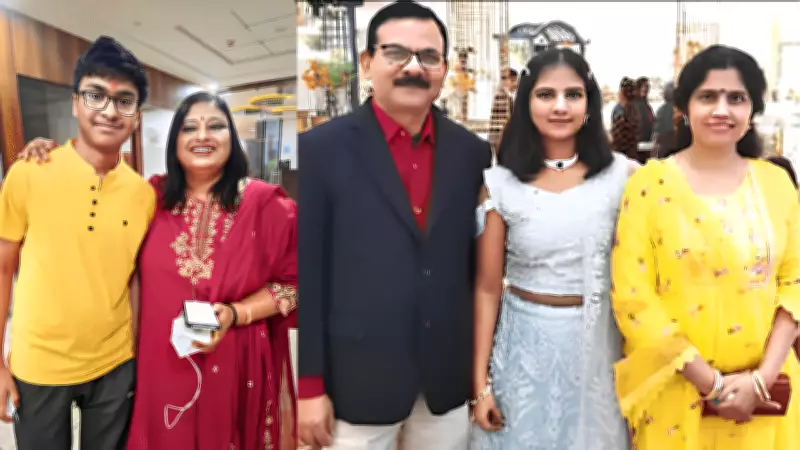
KOTA: For more than two decades, Dr Sunita Sunil Karande's life was measured by eye charts, prescriptions, and surgeries. As an ophthalmologist in Solapur, Maharashtra, her professional identity was ironclad. But between 2022 and 2023, her life could be measured by lunchboxes, mock-test schedules, and the hum of a rented apartment in Rajasthan's Kota.
In 2021, when her son went to Kota to prepare for the National Eligibility cum Entrance Test (NEET), Karande made a choice: she paused her medical practice, left her husband to manage their family hospital, left her daughter in a hostel, and relocated.
"For me, staying in Kota was not just about academic support," Dr Karande says, looking around the modest flat that represents their temporary life. "It was about getting much-deserved mother-son time. As a doctor, I couldn't always be there for my children when they were growing up. In Kota, I could cook his favourite meals and spend time with him every day."

Thousands of miles away from his tech desk, Kapil Sharma is experiencing a similar, surreal reinvention. A computer engineer from Rohru, Shimla, Sharma resigned from his corporate job when his son, Varshil, decided to take a drop year for the Joint Entrance Examination (JEE). "Because he dropped a year, we only have one attempt left," Sharma explains, his hands now adept at kitchen chores he never used to do earlier. "I left my job, learned how to cook, and I am here with him full-time so that he does not get distracted. He passed out from a Sainik school and lived in a highly protected environment all these years. He wasn't ready to face this alone."
Then there is Nishu Kumari, from Bhagalpur, Bihar. Her commitment to Kota isn't a matter of months; it is a decade-long sentence. She has relocated to the coaching city with her two daughters, one in Class 7, the other still in kindergarten. She expects to remain here alone with them until both take their entrance tests, a plan that will keep her marriage operating across a geographic fracture for over ten years.
"I will stay here alone with them," Nishu says. "It's a sacrifice we are entirely willing to make."
The Shared Dream
In the beginning, the dream is almost always the child's: an IIT seat, a medical college admission, a future secured by a rank, a score, a name on a PDF list. But, somewhere along the way, in the neon-lit coaching corridors and cramped, identical rented apartments of Kota, the dream morphs into a massive family enterprise.
Every year, thousands of middle-class Indian parents uproot lives they spent decades building and move to this city built entirely on aspiration. Mothers leave careers, friendships, and familiar domestic routines. Fathers request work-from-home accommodations or divide themselves brutally between two addresses, earning a living in one city to sustain a high-stakes dream in another. Grandparents step in as caregivers, cooks, and emotional anchors. Homes become transient, rented flats.
The 2.5 lakh students who descend upon Kota each year are, of course, the most visible residents of the city, moving between classrooms and hostels with the determined, anxious urgency of people racing an invisible clock.
But they are only half the story.
The other half waits outside the gates of coaching centres, holding flasks of warm milk and tiffin boxes full of cut fruit. This adult half studies mock test scores like stock portfolios, learning to navigate the restless nights before results, the strained, heavy silences after setbacks, and the delicate, terrifying balance between encouragement and pressure.
When Entire Families Relocate
Coaching operators estimate that nearly 20,000 families annually relocate to Kota for a few years at a time. It has given rise to a unique demographic of "co-studying" parents.
Nandlal Kumar left Nalanda in Bihar and moved to Kota with his wife and two children eight years ago. His daughter, Laxmirani, was in Class 6 then; this year, she finally appeared for NEET. His son Anand, a fourth-grader when they arrived, is now a teenager preparing for JEE 2028. The family lives in a rented apartment where daily life is strictly dictated by the coaching institutes' timetables.

To fund this marathon, Kumar's life has been split in two. His real estate and brick kiln businesses remain in Bihar, managed with his elderly father's help. He commutes back and forth when absolutely necessary, carrying the earnings back to Kota to keep the educational machine running.
For Ujjala Sarkar and her husband, retired Air Force Captain Arunkumar Sarkar, the calculation was supposed to be short-term. Three years ago, Arunkumar retired from the Jodhpur air base and moved the family to Kota so their younger daughter, Pratyasha, could prepare for NEET.
"Time in Kota has been entirely about Pratyasha's studies," Ujjala says. The family's calendar was measured not by festivals or holidays, but by mock tests. After Pratyasha took the NEET exam this year, the family finally packed their bags and travelled to Vrindavan, believing the long vigil was over. Then came the devastating national announcement that the examination would have to be retaken due to irregularities.
"So, here we are," Ujjala says with a sigh. "Back in Kota, starting over."
When the parental unit cannot move entirely, the wider family structure steps in. When Jaya Lahoti, mother of JEE Advanced 2024 topper Ved Lahoti, had to leave Kota for five months due to family exigencies, Ved's grandfather, Ramesh Chandra Somani, packed his bags to take her place as the primary pillar of support.
Yet, this lifestyle demands an unyielding internal stamina. "The city runs on a relentless cycle of classes, tests, and preparation. It demands tremendous discipline and energy, not just from the student, but from the parent," cautions Prasad Deshpande, father of Arohi, the all-India girl topper of JEE Advanced 2026.
The Multigenerational Safety Net
The faces in Kota's high-density coaching districts increasingly belong to grandmothers who have stepped into the roles of full-time wardens.
Aradhya Yadav arrived from Etawah, Uttar Pradesh, with her mother and brother. But while her mother desperately longed to return home and her brother struggled to adapt to the gruelling pace of the coaching institutes, Aradhya begged to stay. The compromise? Her 70-year-old grandmother, Urmila Devi Yadav, became a permanent Kota resident.
"Someone had to stay with her," Urmila says, adjusting her sari. "I had no choice." For two years, this septuagenarian has operated as a guardian, late-night cook, and teenage confidante.
The phenomenon crosses socioeconomic divides. Priyanka Parekh from Gujarat spent three years in Kota with her daughter, managing the isolation by enrolling in and earning an MA degree herself while her daughter attended NEET classes. On the other end of the spectrum, Shobha Mahawar works punishing hours as a domestic cook in multiple households and sweeps the floors of Kota's student hostels, doing backbreaking manual labour just to ensure her daughter, Seema, can afford quality coaching.
The Crushing Math Of Failure
Every parent who signs a lease in Kota knows the mathematical odds they are playing against.
Roughly 14 lakh students take the JEE each year for a minuscule 18,000 seats across the elite IITs. More than 22 lakh candidates appear for NEET, competing for a tight pool of about 1.2 lakh medical college seats.
"Priorities have changed for middle-class India," says Allen Career Institute founder director Rajesh Maheshwari. "Today, it is roti, kapda, aur shiksha (food, clothing, and education)."
But what happens when the massive financial and emotional investment does not add up?
Lalman Yadav, a government schoolteacher from Ambedkar Nagar in Uttar Pradesh, has been financially supporting his son's Kota journey since 2024. This year, his son failed to secure an IIT seat through JEE Advanced. Now, the boy wants a second chance.
"Another year will be incredibly expensive, but we are trying to manage somehow," says Yadav. Between coaching fees, accommodation, and daily living expenses, the city burns through Rs 4-5 lakh of his income annually. They have avoided taking an education loan so far, but the financial margins are thinning to a razor's edge.
The dilemma is hauntingly familiar across the city's residential colonies. Sanya Bhoomi arrived in Kota from Noida in 2024. She cleared JEE Main but missed the cut-off rank for the IITs in JEE Advanced. Now, her family faces the agonising gamble that confronts thousands: accept a seat at a lesser-known engineering college, or spend another half-a-million rupees and an immense amount of emotional endurance on a second attempt.
The decision is never purely academic. It involves the unspoken weight of how much debt a family can absorb, and how long an adult life can be paused before the sacrifice becomes toxic.
The Art Of Resilience, And Its Dark Side
For parents, the erosion of their personal lives happens so gradually that they barely notice it at first: a promotion deferred, a medical practice scaled back, a second household budget managed on credit cards. But over time, the emotional investment becomes far more volatile than the financial one.
When a parent gives up their career, their marriage's proximity, and their personal identity for a child's exam, that sacrifice can inadvertently become a psychological guillotine for the student.
"For some parents, a child's success becomes entirely intertwined with their own personal sacrifices," explains Dr Himanshu Sharma, head of Allen's Sanishtha Emotional Well-being Centre. The centre, established in response to the tragic spikes in student suicides in the city, is entirely free and saw a staggering footfall of 30,000 students and parents last year.
Dr Sharma argues that in modern Kota, the parents need psychological counselling just as much as the children. "The first three months are about physical adjustment to the city. The next three are about building confidence and routine. Only after that does the real, psychological race begin."
This advice reflects the heaviest truth about the city. Kota is globally marketed as a triumphant training ground for India's future scientific and medical elite. However, it is also a landscape that recorded 17 student suicides in 2024, following a tragic peak of 26 in 2023. For the thousands of families navigating its streets, the city is a brutal, mandatory crash course in patience, structural resilience, and the deeply difficult art of supporting a young child's dream without accidentally consuming their life in the process.
This is one of the quiet migrations quietly reshaping modern India, driven by an unyielding hope, specifically, the fierce, middle-class belief that education remains the single surest bridge between what is and what might be.
Kota has become the stark geography of that national faith. Its streets remain permanently lined with institutional hoardings and unprecedented parental devotion: lunchboxes carried up steep apartment staircases, careers abandoned on desks back home, lifetime savings stretched to the breaking point, and adult lives temporarily, hopefully, suspended.
Why star kids are a class apart
For students most likely to make the headlines, life in Kota can look surprisingly cushioned. Coaching institutes, long associated with relentless competition and pressure, have built enclaves of comfort around their brightest prospects. The perks extend well beyond academics: residential facilities, curated meals, festival celebrations and even organised outings for families who have uprooted themselves in pursuit of a rank.
"We don't have to worry about anything," says Payal Goyal from Mohali, whose son, Ishan, secured AIR 113 in JEE Advanced 2026. "From Mother's Day outings to Holi celebrations, they take care of us."
The attention is deliberate. Students identified as potential top performers and their parents are often housed separately and provided amenities that feel more like a premium residential campus than a coaching hostel. Meals come with an array of choices, from fresh salads to dessert, and a dedicated support team handles everything from logistics to emotional well-being.
At the centre of this ecosystem is often a designated caretaker, part concierge and part local guardian. "She takes care of all our needs," says Sutapa Sanyal from Midnapore. "Whether we want to go on a day trip or need help with something else, she is just a phone call away."
The care can extend into unexpectedly personal territory. One parent, who began experiencing severe hair loss after relocating to Kota with her son, was referred to a leading doctor in Delhi. Consultations, treatment, medicines and hair care products were arranged, with the coaching institute covering the expenses.