

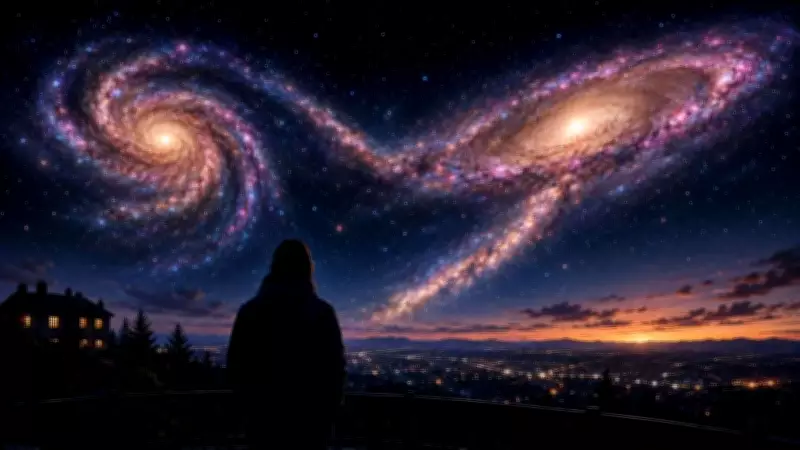
Imagine waking up after 4.5 billion years. Your alarm goes off at 5 am, and you step outside for fresh air. The air is cool, the world still sleepy. Suddenly, a strange light catches your eye. The sky looks otherworldly, like a painting. Streaks of flowing rivers filled with stars stretch across the horizon. This could be the night sky far in the future, if Earth still exists. In approximately 4.5 billion years, the night sky above Earth will undergo a transformation unlike anything in human experience. Our Milky Way's neighbor, the massive Andromeda Galaxy, is approaching at about 250,000 mph. Over the next 2 billion years, the galaxies will collide in a gravitational sumo match that will ultimately bind them forever. But will Earth survive? Let's find out.
The Milky Way-Andromeda Collision
The Milky Way galaxy is a large spiral galaxy containing an estimated 100 to 400 billion stars. Our solar system lies about 26,000 light-years from the galactic center, in a smaller spiral region called the Orion Arm. But our galaxy is not alone. The neighboring massive galaxy, the Andromeda Galaxy (M31), in the Local Group of galaxies, is moving towards us. It contains about 1 trillion stars and has a mass similar to the Milky Way, about 800 billion times the mass of the Sun. It spans approximately 220,000 light-years across, making it the largest galaxy by diameter in our local universe. Like the Milky Way, it is a spiral galaxy with a supermassive black hole of about 100 million solar masses. Andromeda lies approximately 2.54 million light-years from the Milky Way, perhaps the most distant object visible to the naked eye. This proximity is crucial because most galaxies are far more distant.
As early as 1912, astronomers knew Andromeda was headed our way. It moves towards us at approximately 110 kilometers per second relative to the Local Group's center of mass. The two galaxies will approach each other, eventually becoming 'Milkomeda,' as it is now nicknamed. A century later, with NASA's Hubble Space Telescope, scientists measured Andromeda's motion and found negligible sideways movement, indicating a head-on collision seemed inevitable. However, it would not be a violent smash but a slow merger resulting in an elliptical galaxy. New stars, supernovae, and a shift in the Sun's path were expected. Scientists thought the collision was as certain as death and taxes.

Not Inevitable, New Study Says
What was thought to be inevitable may not actually be. Scientists from Helsinki, Durham, and Toulouse universities used data from Hubble and the European Space Agency's Gaia space telescope to simulate how the Milky Way and Andromeda will evolve over the next 10 billion years. They ran 100,000 simulations based on the latest observational data and re-examined the long-held prediction. In findings published in Nature Astronomy, scientists found approximately a 50-50 chance of the two galaxies colliding within the next 10 billion years, contrary to previous belief. Although the new research challenges the accepted fate, the study authors say precise prediction is difficult.
"The Universe is a dynamic place, constantly evolving. We see external galaxies often colliding and merging, sometimes producing cosmic fireworks when gas feeds a central black hole. Until now, we thought this was the fate that awaited our Milky Way galaxy," said lead cosmologist Professor Carlos Frenk of Durham University. "Although its mass is only around 15% of the Milky Way's, its gravitational pull, directed perpendicular to the orbit with Andromeda, perturbs the Milky Way's motion enough to significantly reduce the chance of a merger. While earlier studies considered only the most likely value for each variable, we ran many thousands of simulations to account for all observational uncertainties," said lead author Dr. Till Sawala of the University of Helsinki.
Study co-author Professor Alis Deason of Durham University's Institute for Computational Cosmology noted the significance: "It used to appear destined to merge with Andromeda, forming a colossal 'Milkomeda.' Now, there is a chance we could avoid this fate entirely."

Will Earth Survive?
The new study suggests only a small probability, about 2%, of a head-on collision in the next five billion years. Even if the galaxies do merge, the solar system would be pushed to about three times its current distance from the galactic center. Currently, our solar system sits in the Orion Spur. Even if flung further out, we would end up at the outer edge of this arm. However, by the time of collision, Earth's surface will be too hot for liquid water. The Sun is the real threat: in about a billion years, its luminosity will increase, ending terrestrial life. By 5 billion years, the Sun will expand into a red giant and likely engulf Earth. Humankind will have disappeared billions of years before. "We now know there is a very good chance we may avoid that scary destiny," Professor Frenk added. The irony is that a galactic collision is not our biggest concern.





