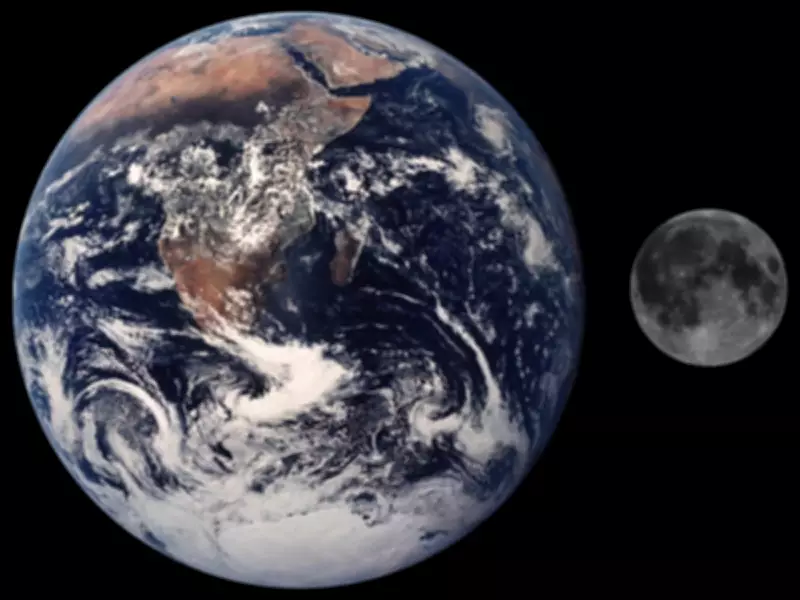
The Moon is gradually moving away from Earth, drifting about 1.5 inches farther into space each year. While this change is imperceptible to the naked eye, it holds significant clues about Earth's ancient past, climate shifts, and the lengthening of days over billions of years.
The Mechanics of Lunar Drift
The Moon's gravity pulls on Earth, creating ocean bulges. Because Earth rotates faster than the Moon orbits, these bulges are pulled ahead of the Moon, exerting a gravitational tug that adds rotational energy to the Moon and pushes it into a higher orbit. This continuous energy exchange is responsible for the Moon's slow retreat.
Evidence from Deep Time
Geological records provide insights into this cosmic dance. A study in the Proceedings of the National Academy of Sciences analyzed 1.4-billion-year-old marine sediments to track ancient climate change using Earth's orbit. Such data help scientists determine how much closer the Moon was and how fast Earth spun in the distant past.

Fossil Shells Reveal Shorter Days
Fossilized clam shells act as ancient calendars. A study in Paleoceanography and Palaeoclimatology used high-resolution chemical analysis of Late Cretaceous rudist bivalve shells to count days in a year. Around 70 million years ago, Earth completed 372 rotations per year, meaning a day was only about 23.5 hours long. This confirms that tidal friction has gradually lengthened days as the Moon moved away.
Modern Impact of Lunar Drift
Today, the Moon's drift influences ocean tides. In coastal cities like New York and Los Angeles, tidal bulges can change water levels by up to five feet, affecting ecosystems and shipping. Although the Moon will never escape Earth's gravity, its slow retreat offers a natural laboratory to study planetary motion and gravitational interactions, reminding us that our planet is part of a dynamic system.
About the Author
The TOI Science Desk is a team of journalists dedicated to covering science news, from genetic engineering to space exploration. They aim to make science accessible and engaging for all readers.