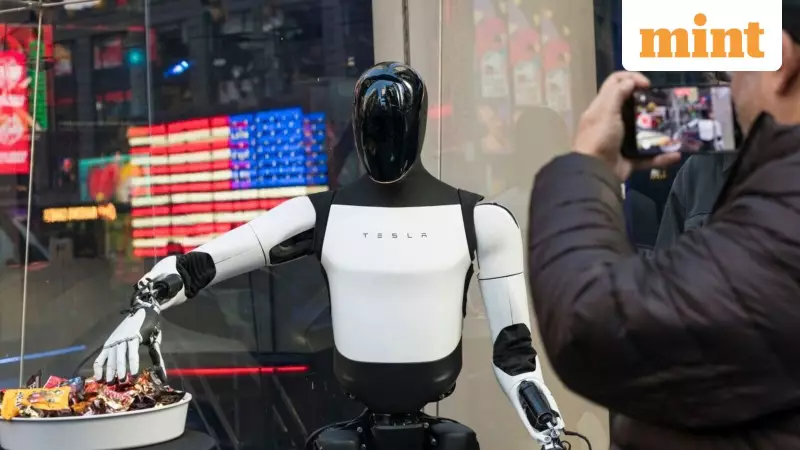
Elon Musk, the billionaire behind Tesla, is placing an enormous bet on a future powered by humanoid robots. He envisions his Optimus robots not just as advanced machines, but as a force that could eliminate poverty and the very concept of work. Musk has told investors these robots have the potential to generate "infinite" revenue and become "the biggest product of all time," fundamentally shifting Tesla's identity from an electric vehicle maker to a robotics powerhouse.
The Grand Vision and the Ground Reality
Musk's vision for Optimus is staggeringly broad. He sees these robots working in factories, handling domestic chores, performing delicate surgeries, and even assisting humans in colonising Mars. To achieve this, he has proposed manufacturing millions of robots annually. This ambition is now tied to his new compensation package, which gives him 10 years to transform Tesla into an $8.5 trillion company and sell at least one million Optimus units to customers. Success could earn Musk a staggering $1 trillion pay package.
However, the present state of Optimus reveals a significant gap between ambition and reality. Currently, each robot is painstakingly assembled by hand. During public demonstrations, such as its red carpet debut at the 'Tron: Ares' premiere in Hollywood in October, the robot is often remotely operated by human engineers wearing body suits and VR headsets. A major technical hurdle is creating a robotic hand with the sensitivity and dexterity of a human hand, a challenge Musk himself has acknowledged.

Navigating a Competitive and Skeptical Landscape
Tesla is not alone in this race. A crowded field of competitors, including Silicon Valley startups like 1X and Figure, established players like Hyundai's Boston Dynamics, and various Chinese robotics firms, are all vying for a share of this nascent market. The appeal of humanoids like Optimus is their bipedal, human-like form, designed to operate seamlessly in environments built for people.
Yet, skepticism persists. Within Tesla, some manufacturing engineers question the bot's usefulness for routine factory tasks, arguing that specialised, non-humanoid robots are often more efficient. Externally, analysts find it difficult to price Tesla's opportunity in humanoids. Even bullish firms like ARK Invest, which forecasts Tesla's share price to reach $2,600, excluded Optimus from its 2029 model, expecting commercial success only later. Morgan Stanley's Adam Jonas, however, predicts the global humanoid industry could generate a massive $7.5 trillion in annual revenue by 2050.
The Long Road from Concept to Companion
The Optimus project began almost as a spectacle. Musk first unveiled the concept in 2021 with a human dancer in a robot costume. A year later, a prototype called Bumblebee was revealed. Development was scrappy, with engineers starting work in a kitchenette, then moving to a basement and later a parking lot. Tesla had to manufacture key components like actuators from scratch.
The core strategy leverages Tesla's expertise in self-driving car AI, treating cars as "robots on wheels." To train Optimus, Tesla employed human data collectors wearing cameras 24/7 and set up bots to continuously navigate office perimeters, learning—and sometimes falling—in the process. Demonstrations in October 2024 at a Warner Bros. soundstage in Burbank, California, showed Optimus bots dancing and serving drinks, though each required a team of engineers for monitoring and teleoperation.
Despite progress in learning simple tasks like sorting Legos or folding laundry, fundamental challenges remain. As Ken Goldberg, a roboticist at UC Berkeley, notes, the frontier is not just the hand, but the integrated ability to perceive, understand, and adapt to an uncertain environment for sensitive tasks. Some competitors, like Standard Bots, argue that wheels are safer and more stable than legs for industrial settings.

Tesla has already moved back its initial timeline for deploying Optimus in its own factories. The company is now on its third generation of the robot. In marketing materials, Optimus is portrayed as a domestic helper—watering plants, unpacking groceries—freeing up time for families. As Musk said in November, referencing Star Wars, "Who wouldn’t want their own personal C-3PO/R2-D2?" For him, this universal appeal is what will make humanoid robots the biggest product ever.