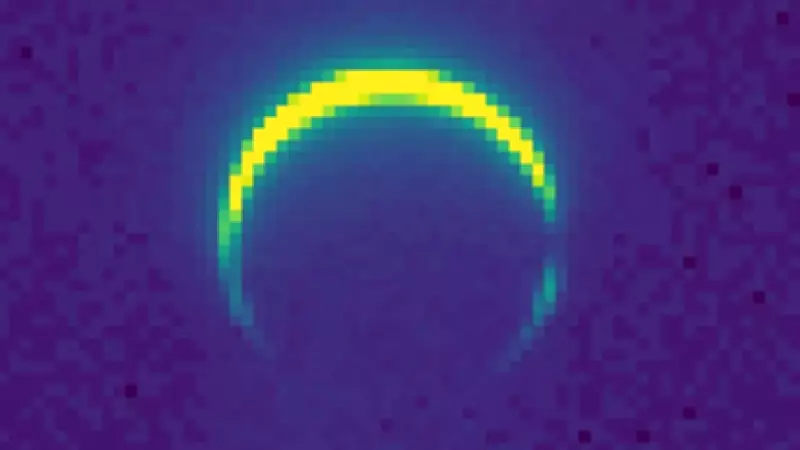
A newly released image from NASA has captured a rare and striking view of Mars, showing the Red Planet as a thin glowing crescent against the darkness of deep space. This unusual perspective, taken by the Psyche mission spacecraft, reveals only a narrow edge of Mars lit by sunlight while the rest of the planet remains in shadow.
The Psyche spacecraft captures a unique crescent view of Mars
The image was captured on May 3, 2026, by NASA's Psyche spacecraft as it approached Mars from a distance of about 3 million miles (4.8 million kilometers). The spacecraft was preparing for a planned flyby on May 15, 2026. Because the spacecraft is approaching Mars from what scientists call a "high phase angle," it sees mostly the night side of the planet, creating the crescent effect. This angle offers a perspective rarely seen by Earth-based observers or typical Mars missions.
According to mission experts, this angle will produce two dramatically different views during the flyby. During approach, Mars appears as a narrow crescent, but after the spacecraft passes the planet, Mars is expected to look much fuller and brighter. Imaging expert Jim Bell noted that these changing views are valuable for testing and calibrating the spacecraft's cameras and imaging systems.

Why NASA's Psyche spacecraft is flying past Mars
The Psyche mission launched on October 13, 2023, with the goal of studying the asteroid Psyche, a massive metal-rich object in the asteroid belt between Mars and Jupiter. Scientists believe the asteroid could provide clues about how rocky planets formed billions of years ago. Traveling that far into space requires a huge amount of energy, so NASA is using Mars to redirect the spacecraft via a gravity assist.
During the flyby, the spacecraft will pass about 2,800 miles above the Martian surface while traveling at roughly 12,333 mph. Mars' gravity will gently alter the spacecraft's path and increase its speed without requiring large amounts of fuel. Gravity assists like this have become an essential part of modern deep-space exploration, allowing spacecraft to travel farther while conserving onboard resources.
NASA prepares to collect massive amounts of data during Mars encounter
The flyby will also allow scientists to collect a large amount of scientific data. The spacecraft's multispectral imager is expected to capture thousands of observations as it moves past Mars. Initial unprocessed images have already arrived on Earth, including distant views of Mars and surrounding starfields. Scientists will later process these images by adjusting brightness and contrast to create a detailed time-lapse sequence of the encounter.
Researchers are especially interested in testing how well the spacecraft performs during fast-moving observations near a planet. The data collected during the flyby could help prepare the mission team for future operations once the spacecraft reaches the asteroid Psyche later this decade.
How the Psyche spacecraft is testing its systems during the flyby
The Mars encounter will also allow NASA to test several scientific instruments onboard the spacecraft. Its magnetometer is expected to study Mars' magnetic environment during the close approach, while the gamma-ray and neutron spectrometer will monitor changes in cosmic radiation around the planet. These tests are crucial because the spacecraft still faces years of travel through deep space, and engineers need to ensure the instruments continue working properly before studying the asteroid.
The spacecraft uses a solar-electric propulsion system powered by xenon gas, which slowly increases speed over long periods rather than relying on short bursts of powerful fuel combustion. Scientists report that the propulsion system has performed well since launch.
Why NASA's rare crescent image of Mars feels so unusual
Mars has been photographed many times by orbiters, rovers, and telescopes, but this crescent image stands out. The unusual angle and lighting make the planet appear more distant and unfamiliar. Experts suggest that such views are relatively uncommon because most Mars missions operate much closer to the planet or observe it from different positions in space. This makes the Psyche spacecraft's perspective particularly valuable both scientifically and visually.

As the spacecraft continues its flyby, scientists and space enthusiasts alike will be watching closely for more images and data. The mission's main destination may still be years away, but this brief encounter with Mars has already delivered one of the mission's most memorable moments so far.