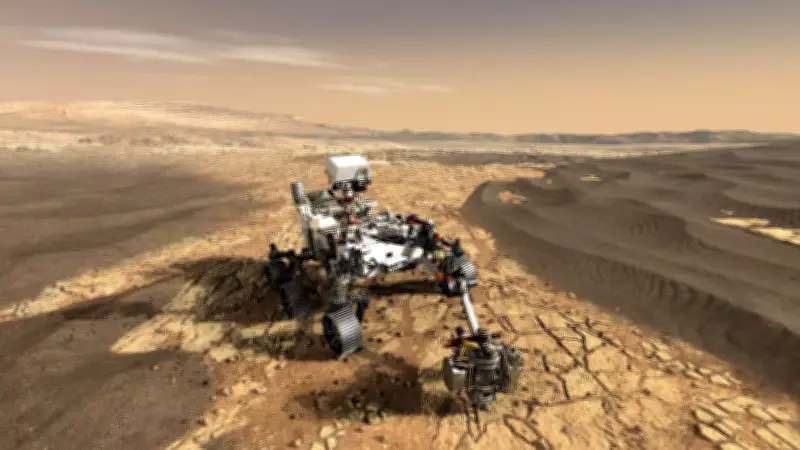
In a groundbreaking development for interplanetary exploration, NASA's Perseverance rover successfully traversed 400 meters across the Martian surface during December, following a meticulously planned route generated by Anthropic's Claude artificial intelligence system. The drives conducted on December 8 and December 10 represent a historic milestone as the first instance where a conversational AI chatbot has orchestrated pathfinding operations for robotic machinery on another celestial body.
Sophisticated AI Training with Extensive Martian Data
The engineering team at NASA's Jet Propulsion Laboratory implemented a comprehensive training approach rather than relying on simplistic prompts. They supplied Claude with years of accumulated rover operational data alongside high-resolution orbital imagery captured by the Mars Reconnaissance Orbiter. This rich dataset enabled the AI system to develop contextual understanding of Martian terrain challenges.
Specialized Programming Language for Planetary Navigation
Claude demonstrated remarkable technical proficiency by generating commands using Rover Markup Language, a specialized XML-based coding system specifically designed for Mars rover operations. The AI meticulously constructed the route by connecting sequential 10-meter segments while implementing self-assessment protocols to critique and refine waypoint selections for optimal navigation efficiency.

Rigorous Simulation Testing Before Implementation
JPL engineers conducted exhaustive validation procedures by running Claude's proposed route through Perseverance's sophisticated digital twin simulation. This comprehensive testing environment evaluated over 500,000 operational variables to identify potential hazards. The simulation revealed a single discrepancy where ground-level camera imagery detected subtle sand ripples flanking a narrow passageway that orbital data had not captured sufficiently.
Engineering teams made precise adjustments to this specific section while confirming the overall route integrity. This meticulous validation process highlights the critical importance of human-AI collaboration in extraterrestrial navigation where environmental uncertainties present constant challenges.
Historical Context of Martian Rover Challenges
The successful AI-assisted navigation carries particular significance given historical precedents. In 2009, NASA's Spirit rover became permanently immobilized after encountering a treacherous sand trap, effectively ending its mission prematurely. This incident underscores why human operators have dedicated countless hours manually plotting cautious navigation paths for Perseverance since its February 2021 touchdown in Jezero Crater.
Overcoming Interplanetary Communication Limitations
The substantial 20-minute signal transmission delay between Earth and Mars eliminates any possibility of real-time joystick control for rover operations. Traditional manual route planning requires extensive time investments from mission specialists. According to JPL estimates, Claude's AI-driven approach reduces this planning duration by approximately fifty percent, dramatically increasing operational efficiency.
This accelerated planning capability translates directly into enhanced scientific productivity through more frequent drives, increased geological sample collections, and expanded research opportunities within Jezero Crater. This ancient Martian basin was specifically selected as Perseverance's exploration zone because it once contained substantial water bodies that potentially supported microbial life forms billions of years ago.
Strategic Importance During NASA Workforce Challenges
The timing of this AI integration proves particularly strategic as NASA navigates organizational transitions. The space agency experienced significant workforce reductions last year with approximately 4,000 employees departing due to budgetary constraints. Tools that enhance productivity for reduced teams become increasingly valuable, especially with ambitious Artemis lunar missions approaching operational phases that will demand substantial resources.

Remarkable Evolution of Anthropic's AI Capabilities
For Anthropic, this achievement represents an extraordinary leap in artificial intelligence development. As recently as last spring, Claude demonstrated capabilities limited to mastering classic video games like Pokémon Red. The transition from virtual gaming environments to navigating authentic alien terrain across 225 million kilometers of interplanetary space illustrates the rapid advancement in AI systems' practical applications for complex real-world challenges.
This successful Mars navigation experiment establishes a significant precedent for future space exploration missions where AI systems may assume increasingly autonomous roles in planetary exploration, potentially revolutionizing how humanity investigates distant worlds beyond our own.