Scientists are analyzing data from NASA's MAVEN mission, which has uncovered patterns in the Martian atmosphere that do not match any known behavior. Initially dismissed as noise or interference, the repeating structured pattern gradually attracted attention, evolving into a scientific question about what might be happening in Mars' upper atmosphere.
Discovery from MAVEN Observations
The discovery stems from observations by NASA's MAVEN spacecraft, suggesting an atmospheric effect never before confirmed on Mars. Scientists believe it could alter our understanding of the interaction between solar wind and the Red Planet. The phenomenon, known as the Zwan-Wolf effect, was previously observed only near Earth. NASA data has revealed this effect hidden within Mars' ionosphere.
The first signs came from magnetic field measurements in the Martian ionosphere. NASA scientists noticed small fluctuations, or "wiggles," in the data during long observation sequences. These changes did not correspond to known Martian atmospheric activity. Initially, they suspected instrument noise or external distortion from solar activity. However, the pattern persisted and became more pronounced during strong solar storms. When charged particles from the Sun hit Mars more intensely, the signals became clearer, prompting researchers to investigate further.

The Zwan-Wolf Effect Explained
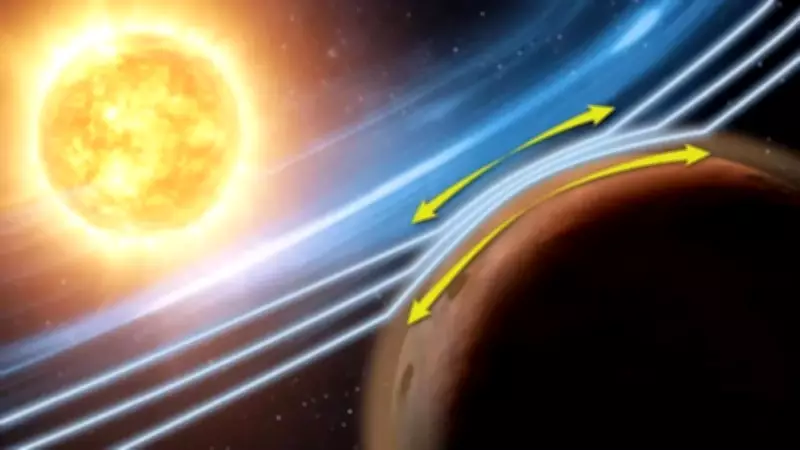
The team eventually focused on a region deep within the ionosphere, below about 200 kilometers above the surface, where charged particles behaved unexpectedly. The phenomenon identified is the Zwan-Wolf effect, first discovered in 1976 but only observed in Earth's magnetosphere until now. On Earth, it influences how charged particles move along magnetic field structures, often described as a squeezing or channeling effect where plasma is pushed through invisible tubes in space. This helps shape how solar wind is deflected around Earth.
What makes the Mars discovery unusual is that the planet lacks a global magnetic field like Earth's. Instead, Mars has a weak, patchy induced magnetic environment created by solar wind interactions. Scientists did not expect such structured behavior to appear in its atmosphere, yet the data suggests something similar is happening in Mars' ionosphere.
Impact of Solar Storms on Mars
Researchers believe the effect was always present at a weak level but undetectable under normal conditions. It became visible only when a strong solar storm hit Mars, disturbing the environment. During such events, the solar wind intensifies and compresses the Martian ionosphere, making charged particles behave more actively. Scientists analyzing MAVEN data noticed that magnetic and plasma readings showed a clearer structure during these times. What was previously hidden in background noise became measurable, with charged particles appearing squeezed and redistributed in a pattern consistent with the Zwan-Wolf effect.
Mars' Atmosphere and Solar Pressure
Mars has a very different space environment compared to Earth. Without a strong global magnetic field, it is directly exposed to solar wind. This constant flow of charged particles interacts with the upper atmosphere, gradually contributing to atmospheric loss over long periods. This is a key reason NASA launched the MAVEN mission—to study how Mars loses its atmosphere and how solar activity affects its ionosphere and climate. If the Zwan-Wolf effect is confirmed as a regular feature of Mars, it could change how scientists model these interactions. Experts suggest this might also apply to other unmagnetized bodies such as Venus or Saturn's moon Titan, though this remains under investigation.
About the Author

The TOI Science Desk is an inquisitive team of journalists dedicated to exploring the realms of discovery, curating a captivating collection of news, features, and articles from the ever-evolving world of science for readers of The Times of India. Consider us your scientific companion, delivering a daily dose of wonder and enlightenment. Whether it's genetic engineering, space exploration, or artificial intelligence, the TOI Science Desk ensures you stay connected to the pulse of the scientific world. We are storytellers of scientific narratives, committed to demystifying science and making it accessible and engaging for all readers. Join us as we craft knowledge with precision and passion, bringing you on a journey where the mysteries of the universe unfold with every word.