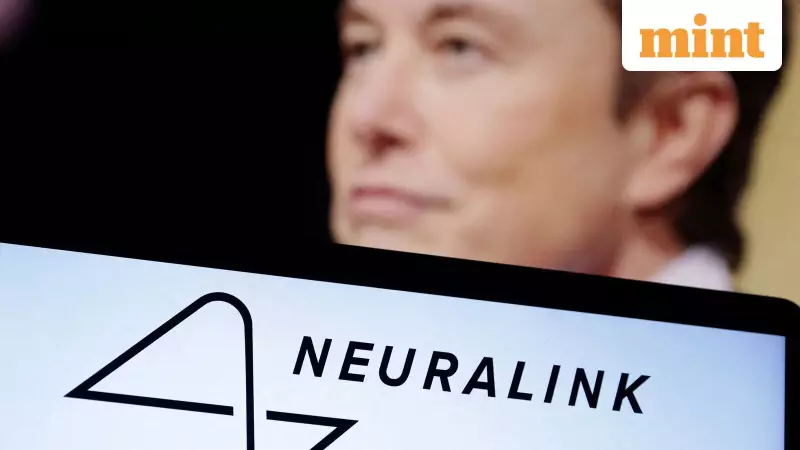
In a significant announcement, tech billionaire Elon Musk has revealed ambitious new timelines for his brain-computer interface venture, Neuralink. The company plans to initiate high-volume production of its brain implant devices and transition to a largely automated surgical procedure by the year 2026.
The Roadmap for 2026: Automation and Scale
Musk shared the update via a post on the social media platform X. He stated that Neuralink will move to a streamlined, almost entirely automated surgical process. A key technical advancement highlighted is that the device's ultra-thin threads will be implanted through the protective dura mater without needing to remove it, which is expected to simplify and improve the safety of the procedure.
The company's current device, roughly the size of a coin, is designed to enable individuals with severe paralysis to control digital interfaces like computers and smartphones using their neural activity. So far, the pioneering chip has been successfully implanted in 12 human patients, as confirmed by Neuralink in November last year.

Life-Changing Results for Early Recipients
The first recipient, Noland Arbaugh, who received his implant in early 2024, has publicly demonstrated its capabilities. He has described using the brain-computer interface (BCI) to play video games like Mario Kart, operate his television, and manage smart home devices purely through thought, without physical movement.
Other implant recipients have reported similar experiences, including playing first-person shooter games and browsing social media. Musk has framed the company's core mission as providing a communication data rate that exceeds normal human capability for those with conditions like quadriplegia or complete loss of brain-body connection.
Beyond Movement: The Vision for Blindsight
Neuralink's ambitions extend beyond motor control. The company's 'Blindsight' project, which received the FDA's "breakthrough device" designation, aims to restore vision. Musk explained that the initial goal is to provide low-resolution sight to those who have lost their eyes and optic nerves, with the potential to eventually surpass the resolution of natural human eyesight and even perceive non-visible wavelengths.
Looking ahead, Musk has previously suggested that over 1,000 Neuralink implants could be achievable by 2026. The planned shift to automated, high-volume production is a critical step toward making this futuristic medical technology accessible to a broader population in need.