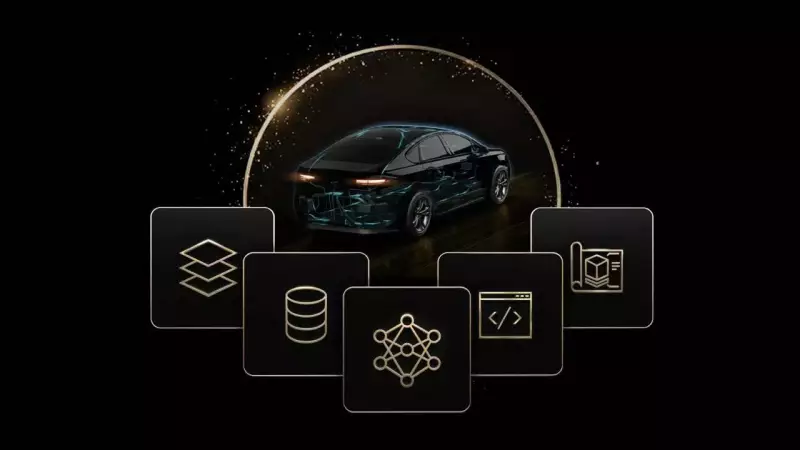
In a major leap for self-driving technology, chip giant Nvidia has unveiled what it calls the world's first "thinking" artificial intelligence for autonomous vehicles. The announcement of the open-source AI model, named Alpamayo, was made by CEO Jensen Huang at the ongoing Consumer Electronics Show (CES).
The 'ChatGPT Moment' for Physical AI Arrives
Jensen Huang positioned the launch as a watershed event, stating that "The ChatGPT moment for physical AI is here – when machines begin to understand, reason, and act in the real world." He explained that Alpamayo brings advanced reasoning capabilities to self-driving systems, allowing vehicles to process rare and complex scenarios, navigate safely in difficult environments, and crucially, explain the logic behind their driving decisions.
The core of this technology is the Vision-Language-Action (VLA) model architecture. This allows the AI to understand visual inputs from cameras, assess the complete driving situation, and then decide on appropriate actions. The system is trained end-to-end, processing data directly from camera feeds to vehicle controls. "It reasons what action it is about to take, the reason by which it came about that action, and the trajectory," Huang added.

Technical Power and Open-Source Access
The first model in the series, Alpamayo 1, is built on a 10-billion-parameter architecture. It uses video input to generate driving paths and provides "reasoning traces" that show the logic for each decision. This transparency is a key feature aimed at building trust in autonomous systems.
In a significant move for the developer community, Nvidia is releasing open model weights and open-source inferencing scripts for Alpamayo 1. Developers can adapt it into smaller models for specific vehicle development or use it as a foundation for tools like reasoning-based evaluators and auto-labeling systems. The company has indicated that future models will be larger, offer more detailed reasoning, and include options for commercial use.
Road to Reality: Partnership with Mercedes-Benz
The theoretical breakthrough is getting a real-world test bed very soon. Nvidia has partnered with Mercedes-Benz to bring this AI to US roads. The technology is expected to debut by the end of this year, starting with the new Mercedes-Benz CLA.
This vehicle will be the first to feature Mercedes's new MB.OS platform, integrated with Nvidia's full-stack DRIVE AV software and AI infrastructure. The partnership will initially enhance Level 2 point-to-point driver assistance capabilities. The design will allow for over-the-air updates, enabling future upgrades and new features to be added via the Mercedes-Benz store.
The announcement sparked a reaction from a key industry rival. Tesla CEO Elon Musk commented on the news, suggesting that while achieving 99% capability might be straightforward, solving the final "long tail" of rare edge-case scenarios is "super hard." This highlights the immense challenge that reasoning AI like Alpamayo aims to address.
With Alpamayo, Nvidia is not just launching another driver-assist tool but is attempting to fundamentally redefine how autonomous vehicles perceive and interact with the world, moving from reactive programming to active reasoning.