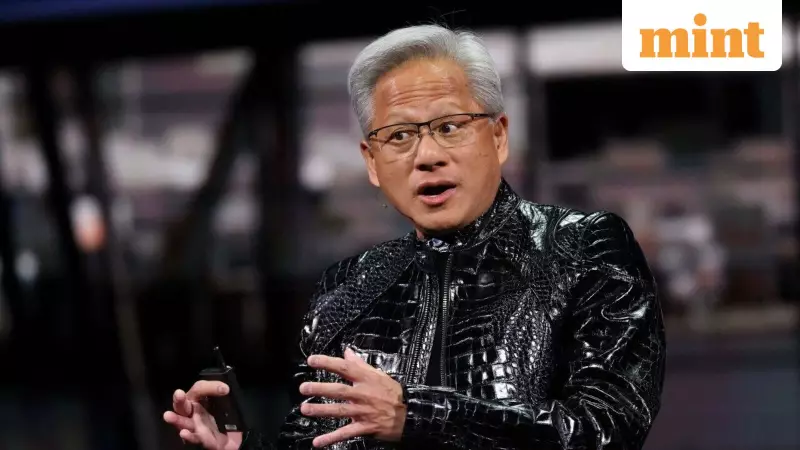
In a significant acceleration of its product roadmap, global semiconductor leader Nvidia has unveiled its next-generation artificial intelligence (AI) chips ahead of schedule. The announcement, made by CEO Jensen Huang at the Consumer Electronics Show (CES) in Las Vegas on Monday, 6th January 2026, signals an intensifying race to dominate the future of computing.
The AI Computing Race Accelerates
Traditionally, Nvidia details its latest chip specifications at its spring developer conference in Silicon Valley. However, the breakneck pace of AI development has forced a change. Jensen Huang, addressing the audience in Las Vegas, stated that the skyrocketing demand for advanced computing to train and operate complex AI models is pushing the entire industry to move faster. "The race is on for AI. Everyone is trying to get to the next frontier," Huang declared, emphasising the paradigm shift where AI inference has become a "thinking process."
The new server systems, named Vera Rubin after the pioneering American astronomer, are set to go on sale in the second half of 2026. They are central to Nvidia's vision of the "omniverse"—a simulated reality where AI models can learn and navigate real-world scenarios, such as training autonomous vehicles, far more efficiently than through real-world trials alone.

Unprecedented Performance Leap with Vera Rubin
The technical capabilities of the Vera Rubin platform represent a monumental leap. Nvidia designed the system anticipating that developers will soon use up to 10 trillion data parameters to train AI models. According to the company, the new Rubin Graphics Processing Units (GPUs) will allow developers to train such a massive model in just one month, using only a quarter of the chips required by the previous generation, known as Blackwell.
For the critical task of inference—where trained AI models respond to user prompts—the cost reduction is even more dramatic. Nvidia claims the Vera Rubin system delivers a 10-fold reduction in inference cost compared to Blackwell. Huang also highlighted that Nvidia has integrated advanced networking and memory-storage products into Rubin, solidifying its position as a top networking hardware company alongside its semiconductor dominance.
Market Impact and Expert Reaction
The early unveiling is a strategic move to reassure the market about Nvidia's innovation pipeline and production timelines. Daniel Newman, CEO of the AI research firm Futurum Group, described Vera Rubin as an "incredible generational leap" based on the disclosed specifications. He noted that announcing the chip this early signals that production is on track and the servers will hit the market swiftly.
Alongside the hardware, Nvidia is promoting new programming libraries and software tools to make its chips more accessible for advanced computing in robotics, autonomous vehicles, and other "physical AI" applications. "Our job is to create the entire stack so you can create the applications that change the world," Huang told the CES audience. Despite the major announcement, Nvidia's share price remained roughly flat through Monday's trading session.
The early reveal of the Vera Rubin systems underscores the ferocious competition in the AI chip sector. As demand for more powerful and efficient computing continues to explode, Nvidia's accelerated timeline sets a new benchmark, forcing rivals and the entire tech ecosystem to keep pace. The era of AI-defined computing is advancing faster than many predicted.