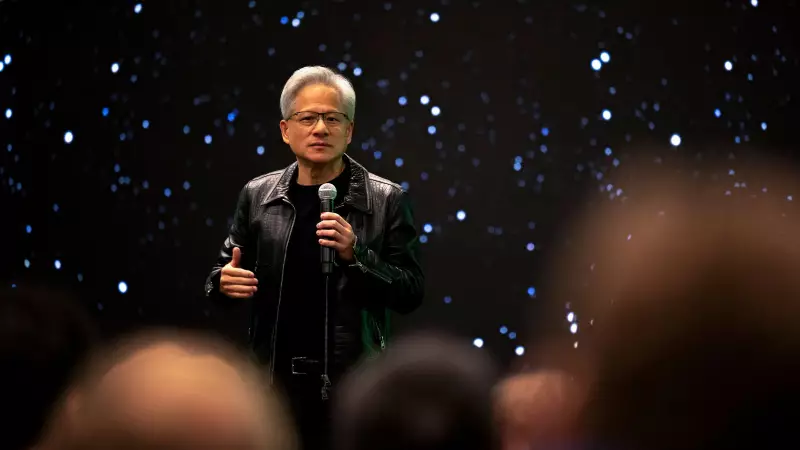
In a major announcement that sets the tone for the year in artificial intelligence, Nvidia CEO Jensen Huang declared that the company's next generation of AI chips is now in full production. The revelation came during a keynote speech at the Consumer Electronics Show (CES) in Las Vegas on Monday, January 6, 2026.
Vera Rubin Platform: A Giant Leap in AI Computing
Huang, leading the world's most valuable company, provided fresh insights into the highly anticipated Vera Rubin platform. He stated that these new processors can deliver a staggering five times the AI computing power compared to Nvidia's previous generation when running chatbots and similar applications. The platform, expected to debut later in 2026, is already being tested by AI firms in Nvidia's labs.
The flagship server configuration will be a powerhouse, containing 72 graphics units and 36 new central processors. Huang demonstrated how these can be combined into massive "pods" with over 1,000 Rubin chips, achieving a 10 times improvement in efficiency for generating AI "tokens," the fundamental building blocks of AI systems.

New Tech and Fierce Competition
To achieve this monumental performance jump, Nvidia is employing a proprietary data type it hopes will become an industry standard. "This is how we were able to deliver such a gigantic step up in performance, even though we only have 1.6 times the number of transistors," Huang explained.
The announcement comes as Nvidia faces intensifying competition. While it dominates AI model training, rivals like Advanced Micro Devices (AMD) and even its own customers, such as Alphabet's Google, are challenging its position in delivering AI services to end-users. Notably, Nvidia recently acquired talent and technology from startup Groq, including executives who helped Google design its own AI chips.
Huang also showcased innovations aimed at improving AI response times, including a "context memory storage" layer to help chatbots handle long conversations more effectively.
Expanding the Ecosystem: Networking and Partnerships
Beyond chips, Nvidia is pushing into networking with a new generation of switches featuring co-packaged optics. This technology is crucial for linking thousands of machines into a single, powerful system and positions Nvidia against established players like Broadcom and Cisco Systems.
On the partnership front, CoreWeave will be among the first to deploy the new Vera Rubin systems. Tech giants including Microsoft, Oracle, Amazon, and Alphabet are also expected to adopt them.
Open-Source Moves and Geopolitical Dynamics
In a significant software announcement, Huang highlighted Alpamayo, an open-source software for autonomous vehicle decision-making. Nvidia is not only releasing the software but also the training data. "Only in that way can you truly trust how the models came to be," Huang asserted.
The geopolitical landscape for chip sales remains complex. Huang confirmed strong Chinese demand for the older H200 chips, which the Trump administration has permitted for export to China. Nvidia's CFO, Colette Kress, stated the company has applied for licenses to ship these chips and is awaiting approvals from the U.S. and other governments.
With the Vera Rubin platform now in production, Nvidia is making a bold statement to both competitors and customers about its determination to maintain its leadership in the defining technology of this decade.