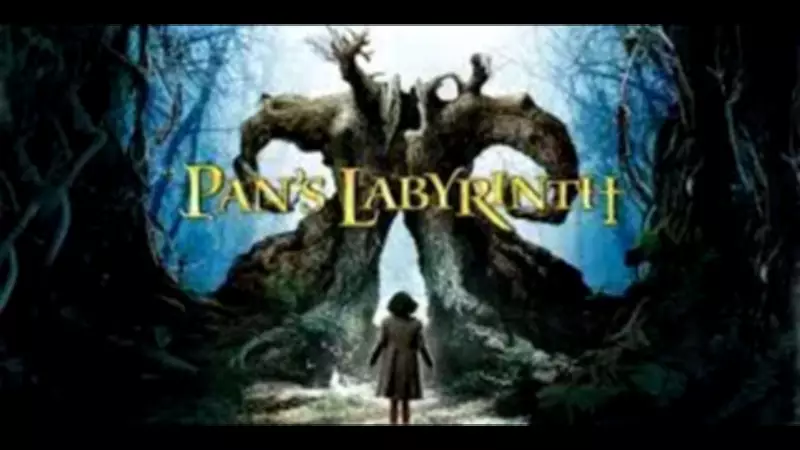
Twenty years after its world premiere shook the Cannes Film Festival with a record 22-minute standing ovation, Pan's Labyrinth returned to Cannes in a new 4K restoration personally supervised by Mexican director Guillermo del Toro. The film screened yesterday as a pre-opening presentation at the Cannes Classics section.
That alone should tell younger audiences something important: some films do not age. They deepen. Every time you watch it, it shows you something new. That is because as we grow, our perceptions change, our life experiences improve our ability to understand old movies in new ways. But certain set rules of the world do not change. Like Fascism. Like bullies. Like war. And the human cost of war. Like hopelessness. Like hope. Like the horror of human behaviour chasing its own ego and seats of power since time immemorial. Like children and their wondrous inner world where they are princes or princesses of an imaginary world. Like fantasy. Dark and foreboding.
Most fantasy cinema today offers escape. Pan's Labyrinth offers the same. But there is a twist. This fantasy is confrontational. Set in Francoist Spain in 1944, the story follows Ofelia, a lonely young girl who moves into a military outpost run by her sadistic stepfather. In the middle of war, torture, and authoritarian violence, she discovers a mysterious labyrinth and a magical creature, who tells her she may be a lost princess. For Gen Z and Gen Alpha — generations raised on infinite scrolling, algorithmic entertainment, emotional burnout, political anxiety, and the collapse of certainty — this is not just a fantasy film from 2006. It feels eerily contemporary. In many ways, it may be the film for this moment. Because beneath the creatures, myths, and fairy-tale imagery lies a brutal story about fascism, innocence, fear, resistance, and the desperate human need to imagine another world when reality becomes unbearable. Feels familiar, does it not?

A Fantasy Film That Refuses Escapism
Most fantasy cinema offers escape. Pan's Labyrinth offers the same. But there is a twist. This fantasy is confrontational. Set in Francoist Spain in 1944, the story follows Ofelia, a lonely young girl who moves into a military outpost run by her sadistic stepfather, Captain Vidal. In the middle of war, torture, and authoritarian violence, she discovers a mysterious labyrinth and a faun (a half-human, half-goat mythological creature from Roman mythology) who tells her she may be a lost princess. But the brilliance of the film is this: fantasy never protects her from reality.
The monsters in the mythical world are terrifying. Yet the real monster is still fascism. Like The Pale Man. He may haunt viewers, but Captain Vidal remains more frightening because he is recognisable. He represents cruelty dressed as order, masculinity weaponised into control, and power emptied of humanity. For a generation growing up amid rising authoritarian rhetoric globally, online radicalisation, wars streamed live on phones, and endless culture wars, the film's political core will feel immediate. Del Toro recently said the film is more pertinent than ever because we live in times that encourage surrender and fear.
It Understands Childhood Better Than Most Films
Modern culture often romanticises childhood or treats it as content. Childhood becomes aesthetic: nostalgic playlists, Y2K fashion, cartoons recycled into memes. But Pan's Labyrinth understands childhood as something darker and more psychologically real.
Disobedience is one of the strongest signals of your conscience of what is right and what is wrong. When you disobey in an intelligent way, you disobey in a natural way, it turns out to be more beneficial than blind obedience. Blind obedience castrates, negates, hides, and destroys what makes us human, Guillermo del Toro said on Pan's Labyrinth.

The children in this film are not protected from violence. Neither are children in any part of the world. In Pan's Labyrinth, they absorb the moral confusion and duality of nature in the adult world. Ofelia does what many young people still do today: she builds an inner universe to survive an unbearable outer one. This is why younger audiences continue to connect deeply with the film. Anxiety, dissociation, maladaptive daydreaming, emotional retreat into fictional worlds — these are now almost common emotional vocabularies online. Entire digital subcultures revolve around escapist fantasy, comfort characters, cottagecore, dark academia, or role-playing identities.
The film is a difficult watch. But it is a must watch. Because it asks a difficult question: when does imagination become resistance, and when does it become surrender?
The Film, Released in 2006, Predicted Our Current Fascination with Soft Horror
Long before TikTok embraced analog horror, uncanny aesthetics, liminal spaces, gothic folklore, or emotionally beautiful monstrosity, del Toro understood something essential: young audiences are drawn to fear when fear reflects emotional truth. The creatures in here are unforgettable not because they are grotesque, but because they feel symbolic.
The Pale Man — with eyes in his hands and a feast nobody should touch — resembles the logic of modern consumption itself. Endless temptation. Endless surveillance. The Faun is equally fascinating because he cannot be trusted completely. Unlike modern franchise storytelling, the film does not flatten morality into simple binaries. Adults lie. Rebels compromise. Magic manipulates. Obedience becomes dangerous. That complexity feels refreshing in an era where online discourse constantly pressures people into absolute moral certainty. If not for any other reason, watch this just for this.
The children in this film are not protected from violence. Neither are children in any part of the world. In Pan's Labyrinth, they absorb the moral confusion and duality of nature in the adult world. Ofelia does what many young people still do today: she builds an inner universe to survive an unbearable outer one. This is why younger audiences continue to connect deeply with the film.
It Is Anti-Algorithm Cinema
This generation consumes more visual content than any generation in history. Yet many people also confess they barely remember what they watch. Streaming has transformed films into disposable data. Stories autoplay. Scenes become clips before they become memories. Cinema increasingly functions as background noise.
Pan's Labyrinth resists this entirely. Every frame feels handcrafted. The practical effects, textures, shadows, costumes, and sound design force viewers to slow down and look. The film was made before digital excess became dominant. Its monsters occupy physical space. Its darkness has texture. For younger audiences raised on compressed streaming images and AI-generated aesthetics, watching this film can feel almost startlingly human.
A Story About Disobedience
Perhaps the film's most radical idea is that obedience is not always moral. Ofelia survives because she questions authority. The fascist regime survives because people follow orders. That theme resonates strongly today, especially for younger generations increasingly sceptical of institutions, corporations, political systems, and inherited social scripts. Across the world, younger people are questioning work culture, nationalism, gender expectations, and systems of power.
The film never romanticises rebellion. In fact, it shows that resistance is painful. Sometimes fatal. But it insists that moral imagination matters. For instance, Mercedes, the housekeeper secretly helping the resistance fighters, becomes one of the film's emotional anchors precisely because she chooses courage quietly. There are no superhero speeches. No grand cinematic heroism. Just ordinary people refusing cruelty. That idea feels deeply relevant in an exhausted era where many people feel politically powerless.
The Violence Shocks for a Reason
One reason the film still unsettles viewers is because its violence is sudden and horrifying. Younger audiences discovering it today are often shocked by how brutal it becomes. But unlike much contemporary violence in entertainment, the brutality here is not designed for spectacle. It exists to destroy romantic illusions about fascism and war. The contrast between fairy tale imagery and raw violence creates emotional whiplash. Del Toro wants viewers to understand that authoritarianism corrupts everything — innocence, beauty, and fantasy itself.
Why the Ending Still Divides Audiences
The ending remains one of the most debated in modern fantasy cinema because the film refuses certainty. Was the fantasy world real? Did Ofelia truly become a princess? Or was it the final refuge of a child? The answer matters less than the emotional truth underneath it. Modern audiences are used to lore-heavy storytelling where everything must be explained. But Pan's Labyrinth trusts ambiguity. It allows mystery to remain unresolved. And perhaps that is exactly what makes it endure. In a culture obsessed with instant explanations, the film leaves space for grief, imagination, and interpretation.
The Film Feels Even More Important in 2026
The return of the del Toro magic to Cannes Classics section is not simply an anniversary screening. It is a reminder of what cinema can still do. The film arrived in 2006, before smartphones dominated attention, before algorithmic feeds shaped taste, before AI began generating images at industrial speed. Watching it now feels like reconnecting with a slower, more tactile, more emotionally sincere form of storytelling.
At Cannes this year, del Toro reportedly warned against a culture that tells people resistance is useless and art can be made with a f***ing app. That may be the strongest reason this generation should watch the film. Because beneath all its monsters and myths, Pan's Labyrinth is ultimately about protecting the human imagination from systems designed to crush it. That battle is very current. And it is yet to be fought.