PM Modi Champions Human-Centric AI at Global Summit, Unveils MANAV Vision
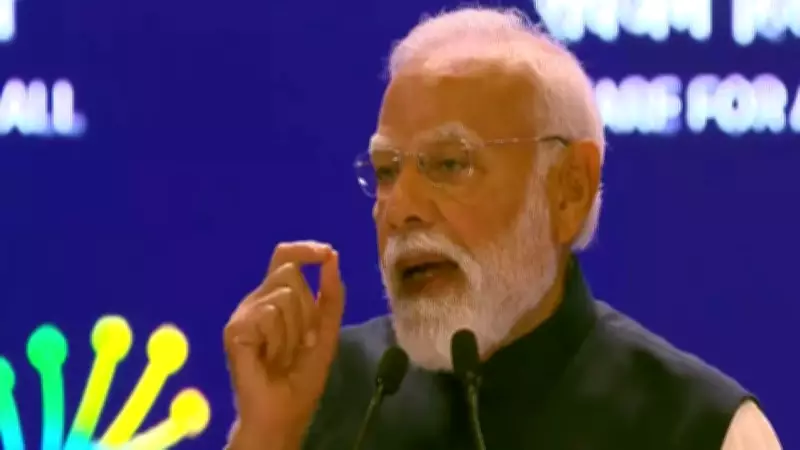
Prime Minister Narendra Modi delivered a powerful keynote address at the AI Impact Summit in New Delhi on Thursday, emphasizing India's commitment to shaping the future of artificial intelligence with a focus on human welfare and ethical governance. The summit brought together world leaders, heads of state, and global technology experts to discuss the transformative potential of AI.
India's Growing AI Ecosystem and Global Leadership
PM Modi highlighted India's strong position in the AI landscape, stating, "India sees a strong future in AI. We have the talent, energy capacity, and policy clarity." He proudly announced that three Indian companies launched their AI models and applications during the summit, showcasing the innovation of the country's youth. The Prime Minister extended an invitation to global stakeholders: "I invite you all to design and develop in India, deliver to the world, humanity."
The MANAV Vision: A Framework for Ethical AI
In a significant announcement, PM Modi presented India's MANAV Vision for artificial intelligence, a comprehensive framework designed to ensure AI development remains human-centric. The acronym MANAV stands for:

- M - Moral and Ethical Systems: AI should operate within ethical guidelines.
- A - Accountable Governance: Transparent rules and robust oversight mechanisms.
- N - National Sovereignty: Data rights belong to those who generate the data.
- A - Accessible and Inclusive: AI should function as a multiplier rather than a monopoly.
- V - Valid and Legitimate: AI systems must be lawful and verifiable.
PM Modi asserted that this vision would serve as "an important link for the welfare of humanity in the AI-based world of the 21st century."
Democratizing AI and Preventing Human Reduction to Data Points
A central theme of the address was the urgent need to democratize artificial intelligence. "For AI, humans are just data points," PM Modi cautioned. "To ensure that humans are not reduced to mere raw material, AI must be democratized." He emphasized that AI should become a medium for inclusion and empowerment, particularly benefiting the Global South.
Drawing an analogy to GPS technology, the Prime Minister explained, "We must give AI an open sky and also keep the command in our hands, like GPS. GPS shows us the way, but the final call on which direction we should go is ours." He stressed that the direction chosen for AI development today would fundamentally shape humanity's future.
Addressing Challenges: Deepfakes, Child Safety, and Global Standards
PM Modi addressed several critical challenges facing the AI ecosystem. He called for establishing global standards to combat deepfakes and fabricated content, which he noted are "destabilising the open society." The Prime Minister advocated for authenticity labels on digital content and the implementation of watermarking and clear-source standards.
Regarding child safety, he stated, "We have to be more cautious regarding children's safety. The AI space should also be child safe and family guided." PM Modi also emphasized the importance of making skilling, reskilling, and lifelong learning a mass movement to prepare for the AI-driven future of work.
Historical Context and Transformative Potential
Comparing AI to other transformative technologies, PM Modi referenced nuclear power, noting that humanity has witnessed both its destructive potential and positive contributions. "Similarly, AI is also a transformative power," he said. "If it gets directionless, then it results in disruption and if gets in the right direction, then it results in solution."
The Prime Minister highlighted the unprecedented speed and scale of AI development, contrasting it with earlier technological revolutions. "Earlier, the impact of technology used to take decades to be visible. Today, the journey from machine learning to learning machines is faster, deeper and wider than ever."

Future of Work and Intergenerational Responsibility
PM Modi expressed optimism about AI's job creation potential, drawing parallels to the internet's unexpected employment impact. "Decades ago, when the internet started, no one could have imagined how many jobs it would create. The same is true for AI," he observed.
He emphasized the collective responsibility in shaping AI's trajectory, stating, "We have to have a big vision and shoulder an equally big responsibility. Along with the present generation, we also have to worry about what form of AI we will hand over to the coming generations." The Prime Minister concluded by framing the central question: "The real question today is not what Artificial Intelligence can do in the future. The question is, what do we do with Artificial Intelligence in the present?"
The AI Impact Summit in New Delhi represents a significant moment in global AI governance discussions, with India positioning itself as a leader in advocating for ethical, human-centric artificial intelligence development that serves all of humanity.