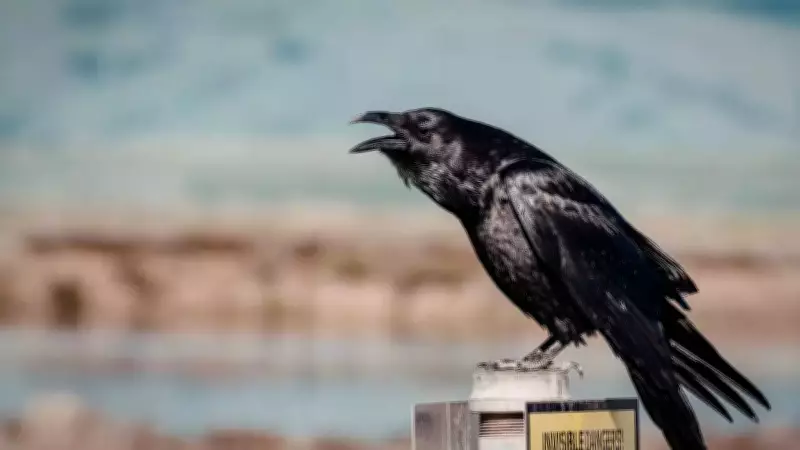
Ravens Redefine Intelligence: Scientific Discovery Reveals Advanced Future Planning Abilities
For centuries, humanity has cherished the belief that planning for the future represents the pinnacle of human intelligence. The ability to envision tomorrow, delay immediate gratification for greater rewards, and strategize for upcoming events has been considered the exclusive domain of intelligent, large-brained primates with complex neural networks. However, a growing body of scientific research is now challenging this long-standing assumption, bringing unprecedented attention to a remarkable bird species that is fundamentally reshaping our understanding of cognitive evolution: the common raven.
Groundbreaking Research Reveals Raven's Planning Capabilities
Recent biological discoveries have demonstrated that ravens possess the extraordinary capacity to forecast their future needs and make decisions not driven by immediate rewards. These findings are revolutionizing established theories about how intelligence develops across species and where true foresight originates in the animal kingdom. The implications extend far beyond ornithology, touching fundamental questions about consciousness and cognitive evolution.
Scientific Study Demonstrates Tool-Based Future Planning
A significant breakthrough emerged from research published in PubMed Central under the title "Ravens parallel great apes in flexible planning for tool-use and bartering." The study aimed to answer a crucial question: Could ravens plan for future situations when the potential reward was no longer visible or immediately available?

In meticulously controlled experiments, researchers trained ravens to use specific tools to open puzzle boxes containing food rewards. After the boxes were removed from the birds' environment, scientists introduced delays ranging from several minutes to nearly a full day. When presented with multiple objects during this waiting period, most ravens consistently selected and retained the correct tool needed for the puzzle box task.
Remarkably, when the boxes were eventually returned, the birds successfully employed their chosen tools to access the food rewards. This behavior demonstrated that ravens were selecting tools long before any opportunity to use them reappeared, with no immediate cues suggesting a forthcoming reward. This cognitive process clearly transcended simple trial-and-error learning or conditioned responses.
Beyond Instinct: Evidence of Complex Cognitive Processing
What makes these findings particularly significant is that ravens were not merely storing food for later consumption—a behavior observed in some bird species—but rather retaining specific tools for particular, unfamiliar tasks they anticipated encountering. Since tool use of this sophistication remains rare among wild birds, the behavior cannot be adequately explained as hardwired instinct alone, suggesting more complex cognitive processing at work.
Context Within Animal Intelligence Research
Previous research had already established that certain bird species, such as scrub jays, possess the ability to predict where and when to cache their food supplies. However, the raven studies represent a substantial advancement by demonstrating planning capabilities in completely novel situations involving both tool utilization and object trading.
This distinction proves critically important within cognitive science. Planning for scenarios beyond an animal's normal wild behavior provides compelling evidence of domain-general intelligence—the capacity to apply thinking skills flexibly across various situations and challenges. The research suggests ravens are not merely reacting to immediate environmental stimuli but actively preparing for future circumstances they anticipate encountering.
Social Planning and Delayed Gratification Experiments
Scientists further investigated whether ravens could demonstrate planning abilities within social contexts. In these experiments, researchers presented the birds with a fundamental choice: accept an immediate, smaller reward or wait for a token that could later be exchanged for a superior prize.

The ravens consistently displayed a degree of self-control comparable to primates, and in certain bartering experiments, they even outperformed orangutans, chimpanzees, and bonobos. This behavior proves especially noteworthy because ravens do not typically engage in object trading in their natural habitats, indicating the behavior stems from cognitive flexibility rather than instinctual programming.
These collective findings challenge traditional hierarchies of intelligence that have long placed humans and other primates at the pinnacle of cognitive evolution. As research continues to unveil the sophisticated mental capacities of corvids, our understanding of intelligence itself continues to expand and transform, reminding us that cognitive brilliance manifests in diverse forms throughout the animal kingdom.