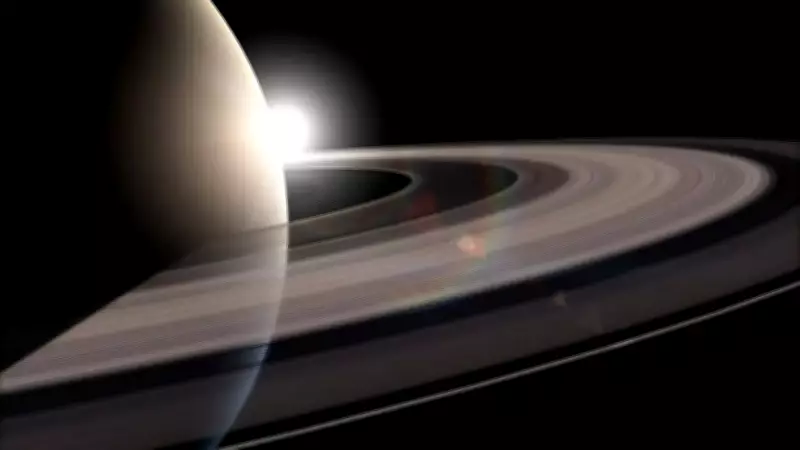
Saturn, with its majestic rings and pale golden bands, is one of the most recognizable objects in the Solar System. However, beneath its imposing appearance lies a surprising reality: it is the least dense planet, with an average density lower than that of water. This fascinating fact reveals much about the nature of this giant world, which is composed primarily of light elements.
How Saturn Became a Giant Without Becoming Dense
Unlike the rocky planets closer to the Sun, which are made of dense materials like iron and silicate rock, Saturn formed from hydrogen and helium—the same elements that dominate the Sun. About 4.5 billion years ago, gravity pulled these light gases together to form a vast globe measuring roughly 120,500 kilometers across. Saturn is essentially an enormous envelope of gases and fluids surrounding a compact interior. Much of its colossal size comes from material that weighs relatively little, resulting in a planet whose physical presence is far greater than its density suggests.
A Planet with No Surface to Stand On
Images of Saturn might create the impression of a solid surface, but no such surface exists. A spacecraft descending into Saturn would encounter increasingly dense layers of gas before reaching regions of extreme pressure, where temperatures and compression levels become severe enough to crush any conventional spacecraft. Saturn is not a place where an astronaut could stand; it is a gradual transition from atmosphere to fluid layers and, deep down, a dense central core. The planet's enormous size hides a surprisingly delicate structure—much of Saturn is, in a sense, atmosphere.

The Surprising Reason Saturn Is Less Dense Than Water
Planetary size often leads to assumptions about mass and density, but Saturn challenges those assumptions. According to NASA, Saturn has a core containing heavier materials like metals and rocky compounds, but this core is surrounded by extensive layers of hydrogen in different forms, including liquid metallic hydrogen and liquid hydrogen. Because hydrogen is so light, Saturn's volume grows far faster than its density, making it vast without becoming compact. While Saturn still contains about 95 times the mass of Earth, its material is spread across such an immense volume that the overall average density remains surprisingly low.
Why Saturn Remains One of the Solar System's Strangest Worlds
Saturn's rings often dominate conversations, but the planet itself may be even more unusual. According to NASA, Saturn is a world where familiar ideas about what a planet should look like break down. It has no true surface, experiences seasons much like Earth despite being nearly 1.4 billion kilometers from the Sun, and hosts hundreds of confirmed moons. Made largely from the lightest elements, Saturn's grandeur comes less from its contents and more from the immense space those simple ingredients occupy. It is one of the clearest examples that appearances can be misleading, even on a planetary scale.
This article was contributed by the TOI Science Desk, a team of journalists dedicated to bringing captivating science news to readers.