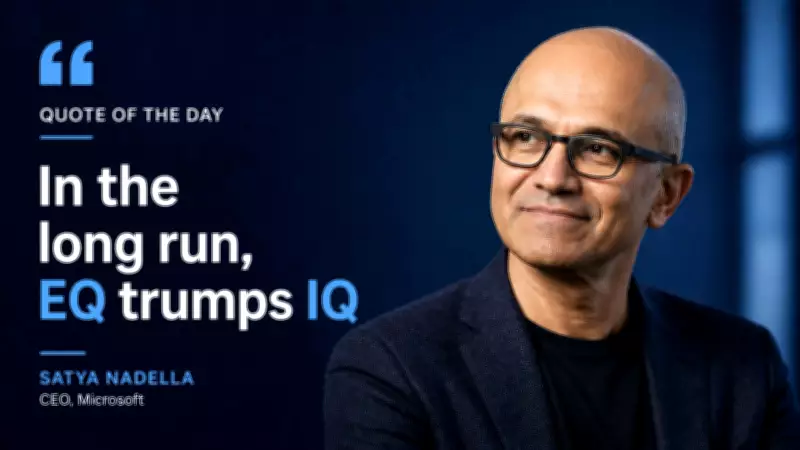
Most leaders spend their careers chasing the wrong metric. They polish their technical skills, stack credentials, and treat intelligence as the primary currency of influence. For a while, it works. Then they hit a wall—usually when the work gets complicated enough to require other people.
Satya Nadella knows this wall well. When he took over as Microsoft CEO in 2014, he inherited a company that was technically formidable and culturally broken. Divisions competed instead of collaborated. Stack ranking—a performance system that literally pitted employees against each other—had gutted internal trust. The company that invented the PC era was losing the cloud era, not because it lacked smart people, but because those smart people had stopped working well together.
Nadella's fix was not a product overhaul. It was a cultural one—centered on empathy, psychological safety, and the belief that the energy a leader creates is as strategically important as any roadmap decision. What followed is now business school material: Azure became a cloud giant, the OpenAI partnership reshaped the AI industry, and Microsoft's market cap climbed from roughly $300 billion to over $3 trillion in a decade. The quote below is what that journey distilled into a single idea.

"The energy you create around you is perhaps going to be the most important attribute—in the long run, EQ trumps IQ. Without being a source of energy for others, very little can be accomplished." ~ Satya Nadella, Chairman and CEO, Microsoft
What Satya Nadella's Quote Actually Means
Nadella is not dismissing intelligence. He is an engineer by training and one of the most technically literate CEOs in tech. He knows exactly what IQ is worth. What he is pointing to is a ceiling. The moment your results depend on other people—and almost all meaningful work does—raw intelligence stops being the binding constraint. What matters then is whether people want to work with you, stay late for you, bring their best ideas to you. That is an energy question. And energy, unlike IQ, is something you actively create or destroy through how you show up every day.
How Nadella Has Actually Lived This
The clearest proof is the cultural shift he engineered at Microsoft. He replaced the "know-it-all" archetype—the person who dominates every room and treats meetings as a place to win—with what he called the "learn-it-all": someone who enters conversations to grow, not to perform superiority. He drew on psychologist Carol Dweck's growth mindset research and embedded it into how Microsoft hired, promoted, and evaluated people. This was not a values poster on the wall. It changed who got ahead.
Nadella has also traced his own EQ development to something deeply personal. Raising a son with severe cerebral palsy, he has said, fundamentally changed how he listens—how he holds someone else's reality alongside his own without rushing to fix or dismiss it. That experience, more than any management course, shaped his leadership philosophy.
The results showed up where it counts. Teams that had been siloed started collaborating. The GitHub acquisition—$7.5 billion for a platform developers genuinely loved—was handled with unusual cultural sensitivity, preserving the community trust that made GitHub valuable in the first place. The OpenAI relationship, arguably the most consequential partnership in recent tech history, required as much interpersonal trust as technical alignment.
Why This Matters Beyond Microsoft
Most organizations reward output and ignore atmosphere. The person who delivers gets promoted. The person who made three others deliver better goes unnoticed. This is a structural miscalculation, and Nadella's quote names it precisely.
Energy compounds. A leader who consistently elevates the people around them does not just add value—they multiply it. Every person they energize becomes a node that energizes others. That effect, sustained over years, outpaces what even the sharpest individual contributor can produce working alone at full capacity. The reverse is equally true and far more common. A brilliant person who drains energy—through dismissiveness, intellectual arrogance, or the quiet signal that collaboration is beneath them—does not just underperform. They suppress the output of everyone around them.

What It Means in Practice
You do not need to run a trillion-dollar company for this to apply. The diagnostic is simple: when you leave a room, do the people in it have more energy than before you arrived, or less? That is not about being the loudest or most enthusiastic presence. It is about attention—whether people feel heard. It is about framing—whether you present problems as possibilities or dead ends. And it is about consistency—whether people trust that engaging with you is worth their effort. None of this requires a personality transplant. It requires noticing, more deliberately, what your presence actually costs the people around you.
Why This Quote Holds Up in the AI Era
As AI takes over more of the technical layer of knowledge work, the differentiation question gets harder to dodge: what do humans contribute that compounds? Nadella's answer—energy, empathy, the ability to move other people—is not a soft consolation prize. It is the specific output that machines cannot replicate and organizations cannot function without. In a world where AI can match or beat most humans on IQ-adjacent tasks, EQ stops being a nice-to-have. It becomes the actual competitive edge. IQ gets you in the room. EQ determines what happens there.
Other Quotes by Satya Nadella Worth Reading
- "Empathy is not a soft skill. It is the hardest skill we can learn."
- "Don't be a know-it-all; be a learn-it-all."
- "Our industry does not respect tradition—it only respects innovation."
- "Every person, organization, and even society lives and dies by the quality of its culture."
About the Author: The TOI Tech Desk is a dedicated team of journalists committed to delivering the latest and most relevant news from the world of technology to readers of The Times of India. Their coverage spans gadget launches, reviews, trends, in-depth analysis, exclusive reports, and breaking stories that impact technology and the digital universe.