

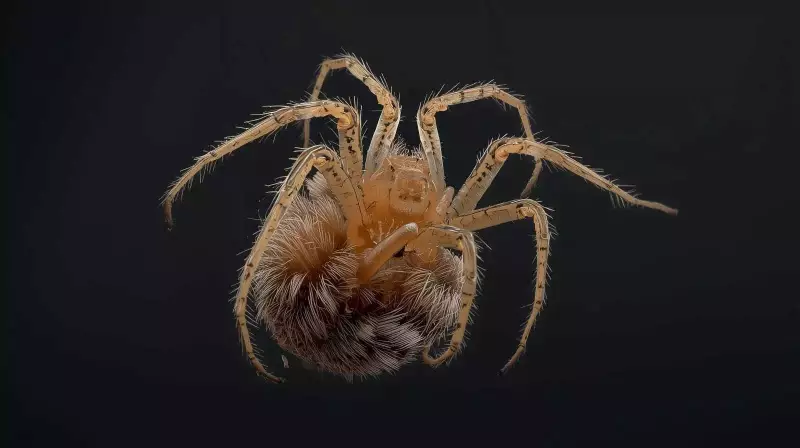
Have you ever noticed a motionless spider tucked in a corner, its legs pulled tightly under its body? This familiar, eerie pose is not a conscious act of defence or a final death throe. It is the direct result of the unique hydraulic system that powers a spider in life and abandons it in death.
The Hydraulic Engine Inside a Spider
Spiders do not move like humans or many other animals. They lack paired muscles for extending their legs outward. Instead, they rely on a clever combination of biology and physics. The muscles a spider possesses are primarily for pulling its legs inward, towards its body. To push the legs out and stand tall, spiders use internal fluid pressure.
This vital fluid is called hemolymph, which functions like blood in insects and arachnids. It circulates under pressure, acting as a natural hydraulic system. When a spider is alive, it meticulously controls this pressure to extend its legs, walk, climb walls, and capture prey. This efficient design is perfect for a creature with very little body mass.

What Happens When the Pressure Drops?
Death for a spider is not a dramatic mechanical failure. It is a quiet fading of control. When a spider dies, the active pressure pushing hemolymph into its legs disappears. With no opposing force, the default inward-pulling muscles take over uncontested. The legs fold inward, curling up beneath the body.
This curling is not a reflex or a response. It is simply gravity and basic physics completing a process that was once actively managed. Over time, the body loses stability, which is why many deceased spiders are found on their backs with legs drawn in.
From Death to 'Necrobotics': Unusual Experiments
This very mechanism has sparked innovative scientific research. Researchers at Rice University have conducted intriguing experiments using deceased spiders. By carefully pumping air into the spider's body, they can re-pressurize the system, causing the legs to extend once more. Releasing the air allows the legs to curl back.
The scientists term these repurposed arachnids 'spider necrobots.' While the name sounds like science fiction, the principle is the same natural hydraulic mechanism, just applied in a novel context. These experiments serve as a powerful reminder that even after life ends, the body's built-in engineering continues to follow its own physical rules.
The next time you see a curled-up spider, you'll know it's not posing. You're witnessing the final, silent result of a remarkable biological system that has simply stopped working.






