Patna: The air in Muzaffarpur's villages should be carrying the sweet fragrance of ripening litchis by mid-May. Instead, many orchards this year smell of damp earth and rot.
For 35 years, Krishna Murari Singh has tended his four-acre ancestral orchard in Rohua Rajaram village of Mushari block, one of Muzaffarpur's major litchi-growing centres. His hands bear the marks of decades spent nurturing trees through droughts, market fluctuations and difficult seasons. Yet this year has left him shaken.
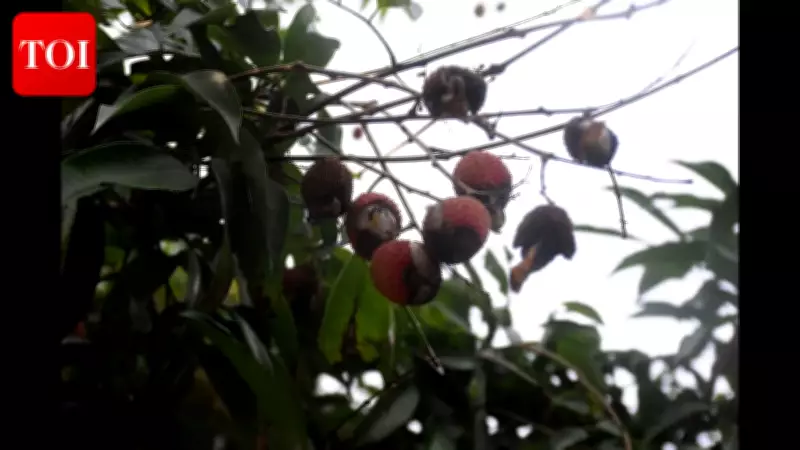
Instead of the bright crimson fruits that usually fetch premium prices in markets from New Delhi to London, he plucks a cluster of shrivelled, brown-skinned litchis from a branch. As he examines them, a shield-shaped insect with a dull brown back and bright red belly crawls across his palm.

The insect is the litchi stink bug (Tessaratoma papillosa), and it has emerged as the symbol of an unprecedented crisis facing Bihar's famed Shahi litchi.
"We have seen bad years, dry years, and years where the market crashed. But we have never seen the trees turn against us like this. The bugs drank the life from the orchards, and the skies finished what was left," Krishna Murari says.
His orchard tells a story that is witnessed across Muzaffarpur and neighbouring districts. Climate change, erratic weather and an explosive pest attack have combined to inflict severe damage on Bihar's GI-tagged Shahi litchi, causing crop losses estimated at up to 70% in some areas.
Broken Climate
The Shahi litchi is a delicate fruit. It thrives only under specific climatic conditions and depends on a carefully balanced weather cycle.
Scientists at the ICAR-National Research Centre on Litchi (NRCL), Muzaffarpur, say the trees require a distinct winter chill to initiate flower bud differentiation. But shrinking winters and rising temperatures have disrupted this natural process, leading to uneven and poor flowering.
The problems did not end there. Unseasonal rain, prolonged cloud cover and hailstorms repeatedly struck major litchi-growing districts, including Muzaffarpur, Vaishali and East Champaran. The weather arrived at the worst possible time, damaging blossoms and young fruits before they could mature.
"Temperatures breaching 38°C in April and May cause massive, premature fruit drop. Intense heat coupled with dry westerly winds blackens the skin, dries up the succulent pulp, and cracks the fruit before it can mature," scientists said.
The consequences have been severe for a crop that contributes significantly to Bihar's rural economy. The state accounts for nearly 40% of India's total litchi production. The Shahi and China varieties are recognised for their sweetness, aroma and high pulp-to-seed ratio. For decades, the fruit has supported lakhs of farmers, labourers, traders, packers and transporters.
For many families, litchi earnings pay for weddings, education and house construction. In large parts of north Bihar, the fruit is more than a crop; it is a seasonal economic lifeline.
This year, however, that lifeline has weakened. The trouble began in March when unseasonal rain lashed orchards just as fruits were settling on the trees. The showers were followed by repeated rains and hailstorms in the last week of April and first week of May, knocking young fruits to the ground.
"The major and first crop loss occurred due to sudden and unusual rains in March this year. The major portion of the remaining developing fruits were washed away by frequent rains and hailstorms in April and first week of May," said Dr Bikash Das, director of the ICAR-NRCL.
Pest Explosion
The unusual weather created another problem. High moisture followed by sudden heat produced ideal conditions for the rapid multiplication of the litchi stink bug. Although the insect is a known pest, farmers and scientists say its population this year reached levels rarely seen before.
The bug attacks tender shoots and fruit stalks, sucking sap from the plant. As nutrients are depleted, fruits fall before ripening. Those that survive often become discoloured and unfit for sale. In many orchards, the infestation has been devastating.

A few kilometres away, Jitu Paswan surveys his orchard of around 200 trees. Besides cultivating his own land, he manages several orchards under sharecropping arrangements. Like many growers, he depends heavily on litchi income. Last year, earnings from the harvest helped him arrange his daughter's wedding and enrol another daughter in a private school. This year offers little such comfort.
"When you walk into the orchard during a normal litchi season, you hear the birds and the bees," Jitu said, pointing to the ground covered with fallen fruits. "This year, if you stand still under the trees, you can actually hear the clicking sound of millions of bugs crawling over the bark. If you shake a branch, they drop on your head. They spray a foul, burning liquid that stains your skin and stings your eyes," he added.
The infestation has left many growers struggling to protect their crops. Sixty-five-year-old Devanti Devi spent her savings on pesticides, spraying her orchard three times. The effort failed as repeated rains washed away the chemicals shortly after application. "I didn't see such a huge crop loss in my entire life," said Devanti.
"This is for the first time in Muzaffarpur region that the stink bug has attacked in such a severe way," said Ashok Kumar Sharma, who heads a farmer producer organisation in Katra block.
The losses vary across the region, but some areas have suffered particularly badly. "An estimated 75% of crops were lost in Minapur block and adjoining areas mainly due to the erratic change in climate and attack by stink bug. Loss is comparatively less in other regions," said Dr Das.
Ripple Effect
The crisis extends well beyond orchard owners. Every summer, thousands of seasonal labourers find work picking, sorting, grading and packing litchis. The fruit's short shelf life requires rapid harvesting and transportation, creating employment across the supply chain.
In a normal season, Mohammad Anwar, a 52-year-old master packer, supervises teams of workers loading crates destined for markets across the country. This year, he sits beside empty wooden boxes. "Usually, by this date, my hands are permanently sticky and stained pink from the juice. I haven't packed a single crate this week. The big wholesalers from Delhi didn't even bother to send their trucks this year. They called us on the phone, heard about the stink bug rot, and cancelled the contracts. No fruit means no work. No work means we go back to our villages with empty pockets," Anwar added.
The economic impact is being felt throughout the region. Many orchard owners sell crops to contractors months in advance, based on flowering intensity and expected yields. This year, numerous agreements have either been renegotiated or abandoned altogether as production collapsed. For farmers already dealing with rising cultivation costs, the losses are particularly painful.
At NRCL, scientists are trying to understand the full scale of the damage. Their assessment points to a larger concern: the crisis is not merely about one pest or one season. It reflects the growing instability of weather patterns that farmers have relied upon for generations. Shorter winters, erratic rainfall, intense heat and violent storms are becoming more common. At the same time, natural predators that help control pest populations have declined in many areas. The result is a farming system becoming increasingly vulnerable to climate shocks.
Back in Rohua Rajaram village, Krishna Murari bends down to pick up a damaged litchi from the ground. He carefully peels away the leathery skin. Inside remains a small pocket of translucent white flesh untouched by rot. He tastes it. The sweetness is still there.
That moment captures both the crisis and the hope surrounding Bihar's most celebrated fruit. The orchards may have suffered one of their worst seasons in recent memory, but the quality that made the Shahi litchi famous remains intact. Scientists warn that unless climate-resilient measures such as micro-irrigation, improved weather forecasting and collective pest management are adopted quickly, the future of the crop could become increasingly uncertain. The sweetness remains. The question is whether future seasons will allow it to flourish.