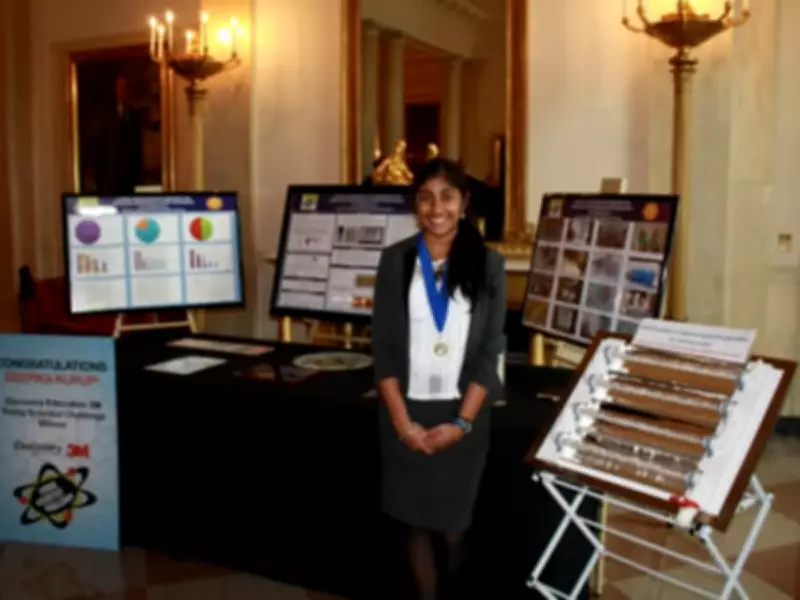
Unlike most teenagers who focus on school projects and exams, Deepika Kurup dedicated her time to solving one of the world's most pressing public health issues: unsafe water. While still a student in Nashua, New Hampshire, she developed a solar-powered water purification invention that harnesses light energy to produce safe drinking water at a reduced cost. This project, unlike typical science fair creations, was grounded in rigorous scientific reasoning.
EPA Recognition for a Green Innovation
According to the United States Environmental Protection Agency (EPA), Kurup created a "green and sustainable" water purification method using solar energy. Her design utilized titanium oxide and zinc oxide, materials that react under sunlight to generate hydroxyl radicals capable of attacking bacteria in contaminated water. The EPA awarded her through the President’s Environmental Youth Awards program when she was a teenager. She later patented the invention and explored ways to implement it in regions with poor water quality.
From Classroom to Real-World Application
Most student inventions never progress beyond classroom demonstrations. Kurup's invention stood out for its practical application. The EPA described it as a "novel light-weight photocatalytic composite" designed for water purification, emphasizing both scientific experimentation and accessibility. The project aimed to create a sustainable solution that could be deployed in areas lacking clean water infrastructure.

The Science Behind Solar Disinfection
The technology is based on solar water treatment principles. Research published in PubMed confirms that solar water disinfection and photocatalysis are effective, eco-friendly, and cost-efficient methods for tackling water contamination. Sunlight activates photocatalysts like titanium dioxide, triggering chemical reactions that harm microorganisms. Photoactivated titanium dioxide exhibits antimicrobial properties useful for water disinfection. Unlike standard filtration, this method uses sunlight to initiate a chemical reaction that kills bacteria, making water safe to drink.
Solar Disinfection in Practice
The concept behind Kurup's project has been employed in countries lacking clean drinking water and modern infrastructure. Solar water disinfection (SODIS) is an affordable approach to reducing waterborne pathogens, used by millions worldwide. Kurup's innovation advanced this by incorporating photocatalytic materials, making sunlight an active part of the disinfection process. This scientific basis distinguished her project from typical school contests.
Challenges in Scaling Up
While solar-based water purification systems hold great potential, scaling them remains challenging. Photocatalytic disinfection systems face issues related to water chemistry and reactor configuration. Despite advantages like no harmful by-products and sustainable solar energy, further development is needed. Kurup's discovery is not the final solution to global water scarcity, but it demonstrates how a novel idea can be applied practically.
Why the Story Endures
Kurup's project continues to resonate due to her youth, scientific relevance, and public importance. It addresses a problem affecting millions worldwide, using concepts long considered promising by researchers. The EPA award and supporting scientific literature add credibility. Kurup showed that a scientific idea could be developed into a real-world application, making her project memorable even after a dozen years.
This article is based on reporting by the TOI Science Desk, a team dedicated to bringing captivating science news to readers.