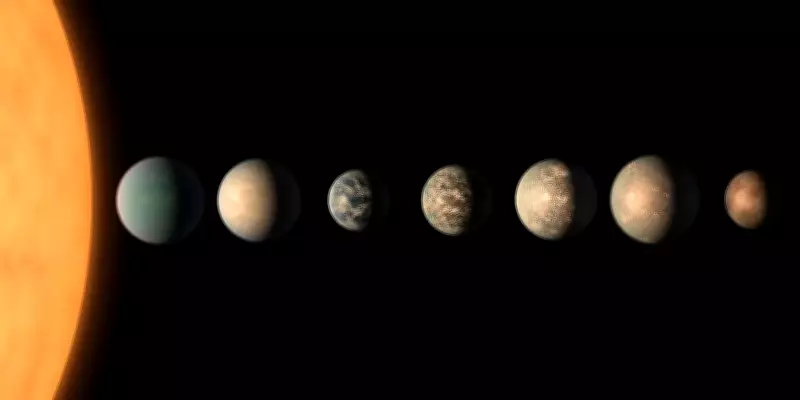
TRAPPIST-1 System: A Revolutionary Discovery in Exoplanet Science
The detection of Earth-sized planets beyond our solar system has fundamentally altered our cosmic perspective, with the TRAPPIST-1 system standing out as a landmark achievement. Located approximately 40 light-years from Earth, this system hosts seven rocky planets that mirror our own in size, offering a unique laboratory for studying extraterrestrial environments.
Unveiling the TRAPPIST-1 Planetary System
Astronomers regard the TRAPPIST-1 system as one of the most significant discoveries in recent history. According to NASA, it consists of seven Earth-like planets orbiting a red dwarf star, earning it the title of the most studied planetary system outside our own. These planets complete their orbits in just a few days due to their close proximity to the star, leading many to be tidally locked—with one hemisphere perpetually facing the star and the other shrouded in eternal darkness.
James Webb Space Telescope Reveals Extreme Temperature Variations
Recent research utilizing the James Webb Space Telescope has provided critical insights into the conditions on these exoplanets. A study titled Thermal emission from the Earth-sized exoplanet TRAPPIST-1 b using JWST demonstrated that one planet experiences intense heating on its day side, with minimal heat transfer across its surface. This indicates a lack of a dense atmosphere to redistribute warmth, resulting in a dramatic temperature divide: one half scorching hot while the other remains frigidly cold.

The findings present clear evidence that heat redistribution is virtually absent on such planets, highlighting their starkly contrasting environments.
Implications for Habitability and Future Exploration
This extreme day-night temperature gap has profound implications for the potential of life. Without an atmosphere to stabilize temperatures, these planets may be too hostile for Earth-like organisms. However, this does not rule out the possibility of other life forms adapted to such extremes.
The TRAPPIST-1 system continues to captivate scientists with its Earth-like planets and unusual composition. NASA poses a tantalizing question about whether this system could host life, driving future missions to investigate atmospheric presence, oceans, and overall habitability. These discoveries underscore that Earth is not a universal standard for habitable worlds, promising many unexpected revelations ahead.