The United States' recent military intervention in Venezuela, culminating in the bombing of the oil-rich nation and the arrest of its President Nicolas Maduro, is being framed as a strategic masterstroke with far-reaching implications beyond geopolitics. The core objective, as stated by the Trump administration, is to assert control over Venezuela's vast oil reserves. This move, analysts suggest, could be the key to unlocking America's dominance in the next great technological frontier: artificial intelligence.
Nvidia CEO's Energy Plea Meets Trump's Action
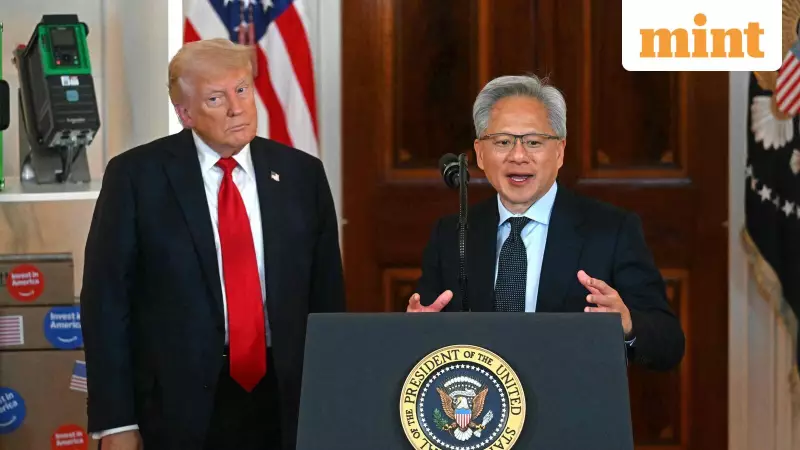
Months before the dramatic escalation in Venezuela, a crucial voice from Silicon Valley highlighted the primary bottleneck for AI advancement. In an October 2025 interview with CNBC, Jensen Huang, the CEO of chipmaking giant Nvidia, laid out the fundamental requirements for AI growth. "AI is several things. AI is energy, AI is chips, the models, and the applications," Huang stated, explaining his company's work across this global ecosystem.
He emphasized a critical need: "We need more energy, we need more chips, we need better models and more models, and we need a lot more applications." This public pronouncement underscored a stark reality – the voracious power consumption of AI data centers and supercomputers requires a massive, reliable energy base.

A "Happy" CEO and a Pro-Energy Policy
During the same interview, Huang explicitly expressed his approval of the political direction in Washington. He said he was "so happy that President Trump leaned into … pro energy growth, so that an entire industry above it could grow." Huang framed energy as the foundational layer, arguing that without such a policy, the entire AI and technology sector above it would be constrained.
He also drew a direct comparison with the United States' chief rival, China. "China is well ahead of … [the US] on energy" Huang acknowledged, but pointed out that America is "way ahead on chips." This analysis paints a clear picture: securing energy dominance is the missing piece to cementing overall AI leadership.
Venezuela's Oil: A Blessing for US AI Companies?
The military action in Venezuela, therefore, appears to be a direct play to address this energy deficit. With Secretary of State Marco Rubio clarifying that the US focus will be on Venezuela's oil sector, a new energy paradigm emerges. If the US successfully leverages Venezuelan reserves to become an energy superpower, it could directly fuel the ambitions of its AI sector.
This potential windfall is seen as a blessing in disguise for Nvidia and other US-based AI pioneers like OpenAI, Microsoft, Meta Platforms, and Oracle. These companies are at the forefront of developing increasingly complex and power-hungry AI models. Access to abundant and controlled oil reserves translates to a more secure and scalable energy supply for the massive computational tasks required.
The strategic calculus is clear: by neutralizing Venezuela's political instability and harnessing its petroleum wealth, the Trump administration aims to build an unassailable energy foundation. This foundation, in turn, is designed to power the American AI industry past Chinese competition, turning Jensen Huang's identified weakness into a definitive strength and shaping the global technological hierarchy for decades to come.