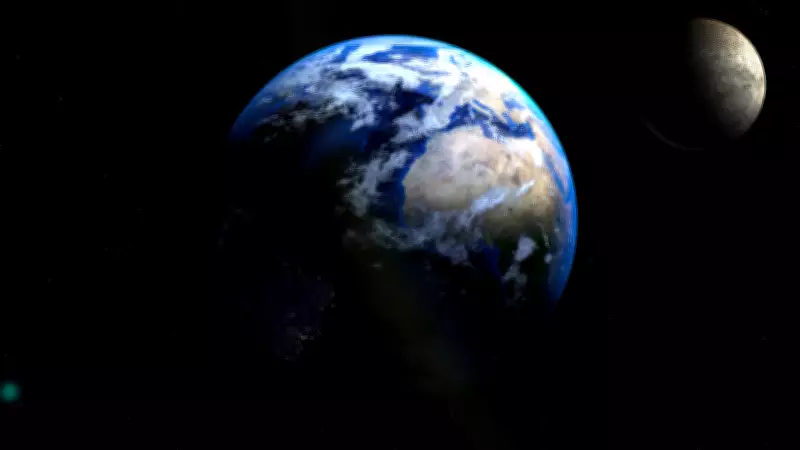
The Moon's revolution around Earth is a fascinating example of gravity and motion in action. While it appears that the Moon simply revolves around our planet, scientists explain that it is actually falling toward Earth constantly but moving sideways at such a high speed that it never crashes. NASA describes this delicate balance of gravity, orbital velocity, and centripetal force that keeps the Moon in its orbit at an average distance of about 384,400 kilometers from Earth. Understanding why the Moon does not collide with Earth provides deep insights into space mechanics, satellite movement, space exploration, and planetary motion throughout the universe.
How Gravity Keeps the Moon from Falling Toward Earth
The Moon is held in place by Earth's gravitational pull, which constantly draws it inward. However, the Moon also moves sideways at approximately 3,680 kilometers per hour. This lateral motion prevents the Moon from plunging into Earth. Sir Isaac Newton famously illustrated this concept using the analogy of a cannonball fired from a high mountain. If the cannonball moves at a low speed, it will fall to the ground. But if it travels fast enough, it will continuously fall around the Earth without ever touching the surface. The Moon operates on the same principle.
A graphic illustration from Cosmoknowledge vividly depicts this: the Moon does not simply orbit Earth; it falls into it. This movement is called free fall. The Moon is perpetually falling due to Earth's gravity, but because Earth curves away beneath it at the same rate, the Moon never makes contact. As NASA states, "An object in space is in orbit when it travels fast enough to miss Earth as it falls."

Orbital Velocity and Why the Moon Never Crashes
Orbital velocity is the primary factor keeping the Moon in its stable orbit. If the Moon traveled slower, gravity would pull it down to Earth. Conversely, if it moved faster, it would escape Earth's gravitational pull entirely. However, the Moon travels at just the right speed to maintain a balanced orbit. This precise speed generates centripetal force, defined by physicists as the force required for an object to follow a curved path. Earth's gravity supplies this force, continuously pulling the Moon along a curved trajectory known as an orbit.
Albert Einstein further advanced our understanding of gravity with his theory of General Relativity. He proposed that massive objects like Earth warp the fabric of space-time, and the Moon follows this curved path as it circles Earth. Despite the apparent stability of celestial orbits, research from the National Radio Astronomy Observatory reveals that the Moon is slowly receding from Earth at a rate of about 3.8 centimeters per year.
Why the Moon's Orbit Matters for Life on Earth
The Moon's orbit does more than provide beautiful nighttime illumination. It drives tidal forces, stabilizes Earth's axial tilt, and influences our planet's climate. Scientists believe that without the Moon, Earth's climate would be far more unpredictable. The Moon's gravitational pull helps regulate the planet's rotation, contributing to a stable environment for life.
Moreover, understanding lunar orbital mechanics was critical for developing spaceflight technologies. Satellites, GPS navigation systems, and missions to other planets all rely on the same orbital principles that keep the Moon in place. While it may seem counterintuitive to think of the Moon as falling, this concept perfectly illustrates orbital motion. The Moon is not floating stationary in space; it is engaged in a complex cosmic dance governed by gravity, velocity, and curved space-time. This phenomenon remains one of the best demonstrations of the laws governing the universe.