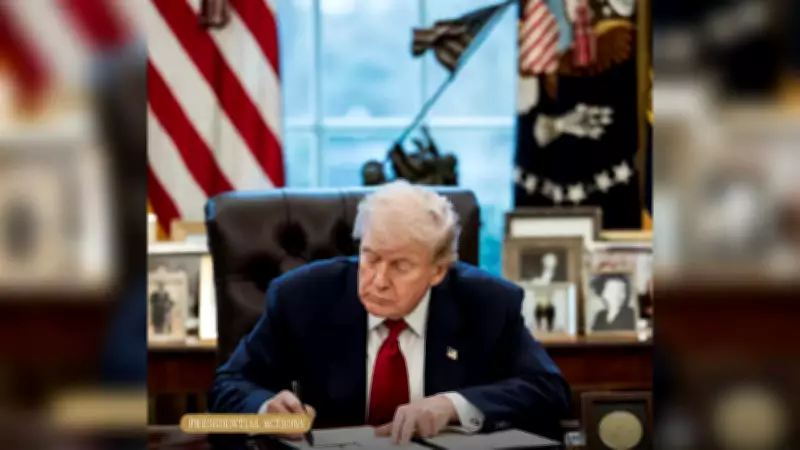
President Trump Issues Sweeping Executive Order to Combat Cybercrime and Fraud
President Donald Trump has signed a significant executive order that directs the federal government to implement comprehensive measures against cybercrime, fraud, and predatory schemes. This initiative specifically targets threats to American families, businesses, and critical infrastructure, marking a robust governmental response to escalating digital dangers.
White House Announces Aggressive Stance Against Criminal Networks
In an official statement, the White House declared, "Today, President Donald J. Trump signed an Executive Order to combat cybercrime, fraud, and predatory schemes targeting American families, businesses, and critical infrastructure." The administration emphasized that President Trump is "unleashing every available tool to stop foreign-backed criminal networks that exploit vulnerable Americans through cyber-enabled fraud and extortion."
The order addresses what officials describe as a crisis-level problem, with data showing rampant cyber threats. It aims to overhaul outdated frameworks and improve coordination to dismantle sophisticated criminal enterprises engaged in ransomware attacks, phishing campaigns, financial fraud, sextortion schemes, and impersonation scams.

Six-Point Plan to Disrupt Transnational Criminal Organizations
The executive order outlines a detailed six-point strategy to combat transnational criminal organizations (TCOs) involved in cyber-enabled crimes:
- Comprehensive Review: Relevant administration officials are directed to conduct a thorough review to identify improvements in operational, technical, diplomatic, and regulatory tools for fighting TCOs engaged in cybercrime.
- Action Plan Submission: The order requires the submission of an action plan that identifies TCOs responsible for scam centers and cybercrime, proposing solutions to prevent, disrupt, investigate, and dismantle their operations. This includes establishing a dedicated operational cell within the National Coordination Center (NCC).
- Prioritized Prosecutions: The Attorney General is directed to prioritize prosecutions of cyber-enabled fraud and scam schemes, focusing on the most serious and provable offenses.
- Training and Assistance: The Secretary of Homeland Security is instructed to partner with the NCC to provide training, technical assistance, and resilience-building against cyber threats for state and local partners.
- Victims Restoration Program: The Attorney General must submit a recommendation for establishing a Victims Restoration Program to return seized or forfeited funds from fraudsters directly to victims.
- International Engagement and Consequences: The Secretary of State is directed to engage with foreign governments, demanding enforcement action against TCOs on their soil. Failure to comply will result in consequences, including sanctions, visa restrictions, limits on foreign assistance, and expulsion of complicit officials.
Addressing Coordination Gaps and Imposing Real Consequences
The White House highlighted that previous efforts have been hampered by "outdated frameworks, gaps in coordination, and lack of real consequences," which have allowed criminal networks to thrive. This executive order seeks to close those gaps by enhancing interagency cooperation and imposing tangible penalties on nations that tolerate predatory schemes.
Officials stress that cyber threats are not isolated incidents but coordinated campaigns run by sophisticated criminal enterprises. The order's multifaceted approach aims to protect vulnerable Americans and secure critical infrastructure from evolving digital threats.